
Ch.16 Amino Acids, Proteins, and Enzymes
Timberlake - Chemistry: An Introduction to General, Organic, and Biological Chemistry 14th Edition
Timberlake14th EditionChemistry: An Introduction to General, Organic, and Biological ChemistryISBN: 9781292472249당신이 사용하는 게 아니라요?교과서 변경
16장, 문제 44a

Pepsin, a peptidase that hydrolyzes proteins, functions in the stomach at an optimum pH of 1.5 to 2.0. How is the rate of a pepsin-catalyzed reaction affected by each of the following conditions?
a. changing the pH to 5.0

검증된 단계별 안내
1
Understand the role of pH in enzyme activity: Enzymes like pepsin have an optimum pH range where they function most effectively. For pepsin, this range is 1.5 to 2.0, which corresponds to the acidic environment of the stomach.
Recognize the effect of pH changes: When the pH deviates significantly from the enzyme's optimum range, the enzyme's structure (specifically its active site) can be altered. This is due to changes in the ionization of amino acid side chains, which are critical for substrate binding and catalysis.
Analyze the given condition: Changing the pH to 5.0 moves the environment to a less acidic (more neutral) condition, far outside pepsin's optimum pH range. This can lead to denaturation or a significant reduction in the enzyme's catalytic activity.
Relate the pH change to reaction rate: At pH 5.0, the rate of the pepsin-catalyzed reaction would decrease dramatically because the enzyme is no longer in its optimal functional state.
Conclude the impact: The pepsin-catalyzed reaction would slow down or potentially stop altogether at pH 5.0 due to the enzyme's reduced ability to bind substrates and catalyze the reaction effectively.

비슷한 문제에 대한 검증된 영상 답변:

이 영상 해법은 위 문제에 도움이 된다고 튜터들이 추천한 것입니다.
영상 길이:
3m
도움이 되었나요?

주요 개념

질문에 올바르게 답하기 위해 반드시 이해해야 하는 핵심 개념들은 다음과 같습니다.

Enzyme Activity and pH

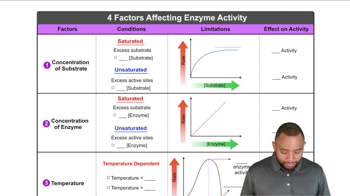
Enzymes, like pepsin, have an optimal pH range where they function most effectively. Outside this range, particularly at higher pH levels, the enzyme's structure can be altered, leading to decreased activity. For pepsin, which operates best at a pH of 1.5 to 2.0, a shift to pH 5.0 would likely result in reduced catalytic efficiency due to denaturation or altered active site conformation.
추천 영상:
가이드 코스
5:33
Factors Affecting Enzyme Activity Concept 2

Pepsin as a Peptidase

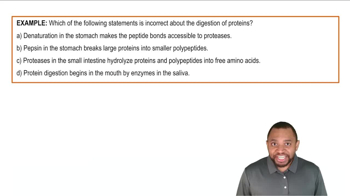
Pepsin is a type of peptidase, an enzyme that breaks down proteins into smaller peptides by hydrolyzing peptide bonds. It is secreted in an inactive form (pepsinogen) and activated in the acidic environment of the stomach. Understanding pepsin's role in protein digestion is crucial for analyzing how changes in conditions, like pH, impact its function.
추천 영상:
가이드 코스
1:17
Digestion of Proteins Example 1

Enzyme Kinetics

Enzyme kinetics studies the rates of enzyme-catalyzed reactions and how they change in response to various factors, including substrate concentration, temperature, and pH. The Michaelis-Menten model is often used to describe these relationships, illustrating how reaction rates can be affected by changes in environmental conditions, such as the pH shift mentioned in the question.
추천 영상:
가이드 코스
01:19
Kinetic Molecular Theory Concept 1