Ch.16 Amino Acids, Proteins, and Enzymes
Timberlake - Chemistry: An Introduction to General, Organic, and Biological Chemistry 14th Edition
Timberlake14th EditionChemistry: An Introduction to General, Organic, and Biological ChemistryISBN: 9781292472249당신이 사용하는 게 아니라요?교과서 변경
16장, 문제 64c

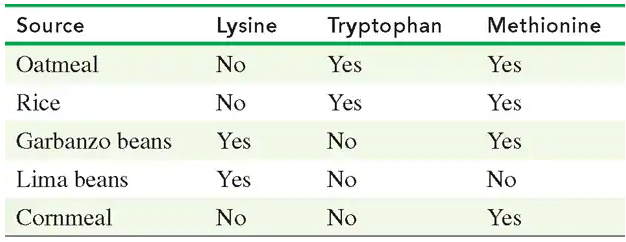
Seeds and vegetables are often deficient in one or more essential amino acids. Using the table in problem 16.63, state whether each combination provides all of the essential amino acids.
Table showing essential amino acid content in oatmeal, rice, garbanzo beans, lima beans, and cornmeal.
<IMAGE>
c. oatmeal and lima beans

검증된 단계별 안내
1
Identify the essential amino acids that are deficient in oatmeal and lima beans individually. Use the table provided in problem 16.63 to determine this information.
Recall that a complete protein source contains all nine essential amino acids in sufficient quantities. Essential amino acids include histidine, isoleucine, leucine, lysine, methionine, phenylalanine, threonine, tryptophan, and valine.
Check whether the amino acids deficient in oatmeal are present in lima beans and vice versa. This will help determine if the combination of oatmeal and lima beans provides all essential amino acids.
If the combination of oatmeal and lima beans compensates for each other's deficiencies, then together they form a complete protein source. Otherwise, they do not.
Conclude whether oatmeal and lima beans together provide all essential amino acids based on the analysis of their amino acid profiles.

비슷한 문제에 대한 검증된 영상 답변:

이 영상 해법은 위 문제에 도움이 된다고 튜터들이 추천한 것입니다.
영상 길이:
3m

주요 개념

질문에 올바르게 답하기 위해 반드시 이해해야 하는 핵심 개념들은 다음과 같습니다.

Essential Amino Acids

Essential amino acids are the amino acids that the human body cannot synthesize on its own and must be obtained through diet. There are nine essential amino acids, including leucine, isoleucine, and lysine, which are crucial for protein synthesis, tissue repair, and nutrient absorption. Understanding which foods contain these amino acids is vital for evaluating dietary combinations.
추천 영상:
가이드 코스
3:03
Amino Acid Catabolism: Amino Group Example 2

Complementary Proteins

Complementary proteins refer to two or more protein sources that, when combined, provide all the essential amino acids that one source may lack. For example, grains and legumes often complement each other, as grains are typically low in lysine while legumes are rich in it. This concept is important for assessing whether a combination of foods, like oatmeal and lima beans, meets the body's amino acid requirements.
추천 영상:
가이드 코스
2:01
Digestion of Proteins Concept 1

Protein Quality

Protein quality is a measure of how well a protein source provides the essential amino acids needed by the body. It is often assessed using the Protein Digestibility-Corrected Amino Acid Score (PDCAAS), which evaluates both the amino acid profile and digestibility. High-quality proteins, such as those from animal sources, typically contain all essential amino acids in adequate amounts, while plant-based proteins may require careful combination to achieve similar quality.
추천 영상:
가이드 코스
2:01
Digestion of Proteins Concept 1