Ch.16 Amino Acids, Proteins, and Enzymes
Timberlake - Chemistry: An Introduction to General, Organic, and Biological Chemistry 14th Edition
Timberlake14th EditionChemistry: An Introduction to General, Organic, and Biological ChemistryISBN: 9781292472249당신이 사용하는 게 아니라요?교과서 변경
16장, 문제 60a

What type of interaction would you expect between the following in a tertiary structure?
a. threonine and glutamine

검증된 단계별 안내
1
Identify the functional groups present in the side chains of threonine and glutamine. Threonine has a hydroxyl (-OH) group, and glutamine has an amide (-CONH2) group.
Recognize that both threonine and glutamine are polar amino acids due to their side chains containing polar functional groups.
Understand that polar side chains can interact through hydrogen bonding. The hydroxyl group of threonine can act as a hydrogen bond donor or acceptor, while the amide group of glutamine can also participate in hydrogen bonding.
Conclude that the interaction between threonine and glutamine in a tertiary structure is likely to be a hydrogen bond, which stabilizes the protein's three-dimensional shape.
Note that these interactions are important for maintaining the overall structure and function of the protein in its folded state.

비슷한 문제에 대한 검증된 영상 답변:

이 영상 해법은 위 문제에 도움이 된다고 튜터들이 추천한 것입니다.
영상 길이:
4m
도움이 되었나요?

주요 개념

질문에 올바르게 답하기 위해 반드시 이해해야 하는 핵심 개념들은 다음과 같습니다.

Amino Acid Properties

Threonine and glutamine are both polar amino acids, which means they have side chains that can form hydrogen bonds with water. This property influences their interactions in a protein's tertiary structure, as polar amino acids tend to be found on the surface of proteins, interacting with the aqueous environment.
추천 영상:
가이드 코스
3:03
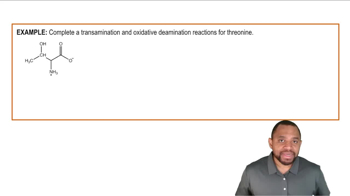
Amino Acid Catabolism: Amino Group Example 2

Hydrogen Bonding

Hydrogen bonding is a key interaction in protein structures, occurring when a hydrogen atom covalently bonded to an electronegative atom (like oxygen or nitrogen) is attracted to another electronegative atom. In the case of threonine and glutamine, their hydroxyl (-OH) and amine (-NH2) groups can form hydrogen bonds, stabilizing the protein's tertiary structure.
추천 영상:
가이드 코스
1:22
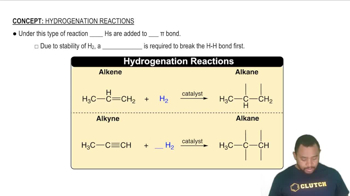
Hydrogenation Reactions Concept 1

Tertiary Structure of Proteins

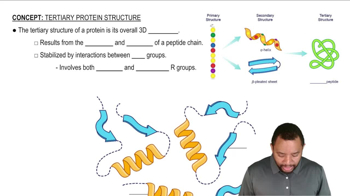
The tertiary structure of a protein refers to its three-dimensional shape formed by the folding of its polypeptide chain. This structure is stabilized by various interactions, including hydrogen bonds, ionic bonds, and hydrophobic interactions, which are crucial for the protein's functionality and interaction with other molecules.
추천 영상:
가이드 코스
2:07
Tertiary Protein Structure Concept 1