Ch.17 Nucleic Acids and Protein Synthesis
Timberlake - Chemistry: An Introduction to General, Organic, and Biological Chemistry 14th Edition
Timberlake14th EditionChemistry: An Introduction to General, Organic, and Biological ChemistryISBN: 9781292472249당신이 사용하는 게 아니라요?교과서 변경
17장, 문제 106

 In DNA, how many hydrogen bonds form between guanine and cytosine?

검증된 단계별 안내
1
Understand the structure of DNA: DNA is composed of nucleotide pairs, where each pair consists of a purine base (adenine or guanine) and a pyrimidine base (thymine or cytosine). These bases are connected by hydrogen bonds.
Recall the base pairing rules: Guanine (G) pairs with cytosine (C), and adenine (A) pairs with thymine (T). This pairing is specific and follows the Watson-Crick model.
Examine the hydrogen bonding between guanine and cytosine: Guanine and cytosine form three hydrogen bonds due to their complementary functional groups. Guanine has donor and acceptor sites that align perfectly with cytosine's donor and acceptor sites.
Visualize the bonding: The three hydrogen bonds between guanine and cytosine occur at specific locations: one between the amino group of cytosine and the carbonyl group of guanine, one between the nitrogen atom of cytosine and the hydrogen atom attached to the nitrogen of guanine, and one between the oxygen atom of cytosine and the hydrogen atom attached to the amino group of guanine.
Conclude the importance of these bonds: The three hydrogen bonds between guanine and cytosine contribute to the stability of the DNA double helix, making GC pairs stronger than AT pairs, which only form two hydrogen bonds.

비슷한 문제에 대한 검증된 영상 답변:

이 영상 해법은 위 문제에 도움이 된다고 튜터들이 추천한 것입니다.
영상 길이:
2m
도움이 되었나요?

주요 개념

질문에 올바르게 답하기 위해 반드시 이해해야 하는 핵심 개념들은 다음과 같습니다.

Hydrogen Bonds in DNA

In DNA, hydrogen bonds are crucial for stabilizing the double helix structure. These bonds form between complementary nitrogenous bases, which are the building blocks of DNA. The specific pairing of bases is essential for accurate DNA replication and transcription.
추천 영상:
가이드 코스
1:22
Hydrogenation Reactions Concept 1

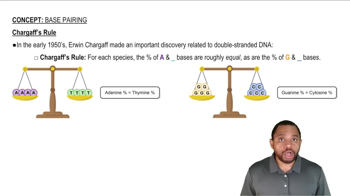
Base Pairing Rules

The base pairing rules dictate that guanine pairs with cytosine (G-C) and adenine pairs with thymine (A-T) in DNA. This specific pairing is due to the number of hydrogen bonds formed: G-C pairs form three hydrogen bonds, while A-T pairs form two. This difference in bonding strength contributes to the overall stability of the DNA molecule.
추천 영상:
가이드 코스
2:01
Base Pairing Concept 2

Structure of DNA

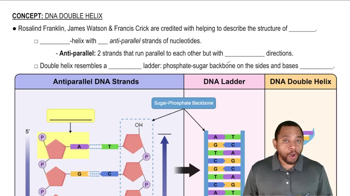
DNA is structured as a double helix, consisting of two strands that wind around each other. Each strand is made up of a sugar-phosphate backbone and nitrogenous bases that extend inward. The arrangement of these bases and the hydrogen bonds between them are fundamental to the genetic information encoded in DNA.
추천 영상:
가이드 코스
3:27
DNA Double Helix Concept 1