Ch.17 Nucleic Acids and Protein Synthesis
Timberlake - Chemistry: An Introduction to General, Organic, and Biological Chemistry 14th Edition
Timberlake14th EditionChemistry: An Introduction to General, Organic, and Biological ChemistryISBN: 9781292472249당신이 사용하는 게 아니라요?교과서 변경
17장, 문제 91a

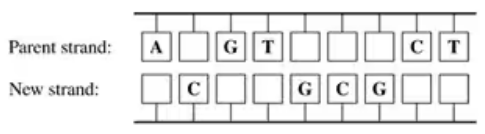
Answer the following questions for the given section of DNA:
a. Complete the bases in the parent and new strands.

검증된 단계별 안내
1
Step 1: Understand the structure of DNA. DNA is a double-stranded molecule where each strand is composed of nucleotides. Each nucleotide consists of a sugar, a phosphate group, and a nitrogenous base. The bases pair specifically: adenine (A) pairs with thymine (T), and cytosine (C) pairs with guanine (G).
Step 2: Analyze the given DNA sequence. If the parent strand is provided, identify the sequence of bases on this strand. For example, if the parent strand has a sequence like A-T-G-C, note that these bases are complementary to the new strand.
Step 3: Apply base-pairing rules to complete the new strand. For each base in the parent strand, write the complementary base in the new strand. For example, if the parent strand has A, the new strand will have T; if the parent strand has G, the new strand will have C.
Step 4: If the image contains partial sequences, complete the missing bases in both the parent and new strands by following the base-pairing rules. Ensure that each base in the parent strand has a corresponding complementary base in the new strand.
Step 5: Double-check your work to ensure that all base pairs are correctly matched and that the DNA strands are antiparallel (one strand runs 5' to 3', and the other runs 3' to 5').

비슷한 문제에 대한 검증된 영상 답변:

이 영상 해법은 위 문제에 도움이 된다고 튜터들이 추천한 것입니다.
영상 길이:
2m
도움이 되었나요?

주요 개념

질문에 올바르게 답하기 위해 반드시 이해해야 하는 핵심 개념들은 다음과 같습니다.

DNA Structure

DNA is composed of two strands forming a double helix, with each strand made up of nucleotides. Each nucleotide consists of a sugar, a phosphate group, and a nitrogenous base (adenine, thymine, cytosine, or guanine). The bases pair specifically: adenine with thymine and cytosine with guanine, which is crucial for DNA replication and transcription.
추천 영상:
가이드 코스
3:27
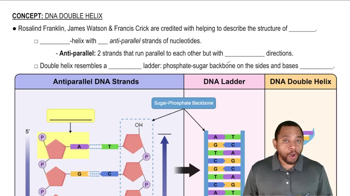
DNA Double Helix Concept 1

Base Pairing Rules

Base pairing rules dictate how nucleotides pair in DNA. Adenine (A) pairs with thymine (T), and cytosine (C) pairs with guanine (G). Understanding these rules is essential for completing the bases in both the parent and new strands of DNA, as they ensure accurate replication and maintain genetic fidelity.
추천 영상:
가이드 코스
2:01
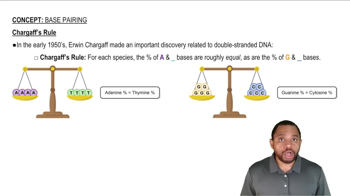
Base Pairing Concept 2

DNA Replication

DNA replication is the process by which a cell duplicates its DNA before cell division. It involves unwinding the double helix and synthesizing new strands complementary to the original strands, following the base pairing rules. This process is vital for genetic continuity and is facilitated by enzymes such as DNA polymerase.
추천 영상:
가이드 코스
1:40
Intro to DNA Replication Example 2