
Ch.17 Nucleic Acids and Protein Synthesis
Timberlake - Chemistry: An Introduction to General, Organic, and Biological Chemistry 14th Edition
Timberlake14th EditionChemistry: An Introduction to General, Organic, and Biological ChemistryISBN: 9781292472249당신이 사용하는 게 아니라요?교과서 변경
17장, 문제 123(1)

Match each of the following processes (1 to 5) with one of the items (a to e):
1. replication of DNA
a. DNA polymerase
b. mRNA is synthesized from nuclear DNA
c. viruses
d. restriction enzymes
e. tRNA molecules bond to codons

검증된 단계별 안내
1
Step 1: Understand the processes listed in the problem. These are biological processes related to DNA and RNA, such as replication, transcription, and translation. Each process involves specific molecules or enzymes.
Step 2: Recall that DNA replication is the process by which DNA makes a copy of itself. This process requires the enzyme DNA polymerase, which synthesizes the new DNA strand by adding nucleotides complementary to the template strand.
Step 3: Match the process of DNA replication (1) with the item 'a. DNA polymerase' because this enzyme is essential for the replication process.
Step 4: Review the other processes and their corresponding items to ensure proper understanding and matching. For example, transcription involves synthesizing mRNA from nuclear DNA, which matches with 'b. mRNA is synthesized from nuclear DNA.'
Step 5: Continue matching the remaining processes with their respective items based on their definitions and roles in molecular biology. For example, translation involves tRNA molecules bonding to codons, which matches with 'e. tRNA molecules bond to codons.'

비슷한 문제에 대한 검증된 영상 답변:

이 영상 해법은 위 문제에 도움이 된다고 튜터들이 추천한 것입니다.
영상 길이:
5m

주요 개념

질문에 올바르게 답하기 위해 반드시 이해해야 하는 핵심 개념들은 다음과 같습니다.

DNA Replication

DNA replication is the biological process of producing two identical replicas of DNA from one original DNA molecule. This process is essential for cell division, ensuring that each new cell receives an exact copy of the genetic material. Key enzymes involved include DNA polymerase, which synthesizes the new DNA strands by adding nucleotides complementary to the template strand.
추천 영상:
가이드 코스
1:40
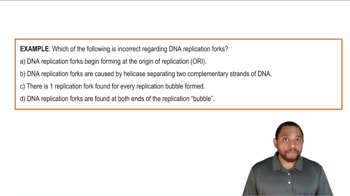
Intro to DNA Replication Example 2

Transcription

Transcription is the process by which messenger RNA (mRNA) is synthesized from a DNA template. During transcription, RNA polymerase binds to the DNA and unwinds the double helix, creating a complementary RNA strand. This process is crucial for gene expression, as it allows the genetic information stored in DNA to be translated into proteins.
추천 영상:
가이드 코스
6:37
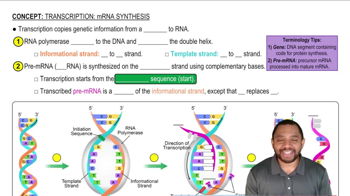
Transcription: mRNA Synthesis Concept 1

Enzymatic Functions in Molecular Biology

Enzymes such as restriction enzymes and DNA polymerase play vital roles in molecular biology. Restriction enzymes cut DNA at specific sequences, which is essential for genetic engineering and cloning. Understanding these enzymatic functions is crucial for manipulating DNA and studying genetic processes, including replication and transcription.
추천 영상:
가이드 코스
04:24
Inverse Logarithmic Functions