Ch.18 Metabolic Pathways and ATP Production
Timberlake - Chemistry: An Introduction to General, Organic, and Biological Chemistry 14th Edition
Timberlake14th EditionChemistry: An Introduction to General, Organic, and Biological ChemistryISBN: 9781292472249당신이 사용하는 게 아니라요?교과서 변경
18장, 문제 28b

How many ATP or NADH are produced (or required) in each of the following steps in glycolysis?
c. phosphoenolpyruvate to pyruvate

검증된 단계별 안내
1
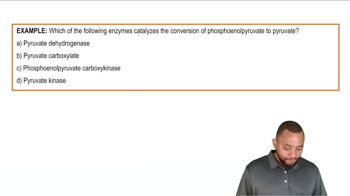
Step 1: Understand the context of the reaction. The conversion of phosphoenolpyruvate (PEP) to pyruvate is the final step in glycolysis, catalyzed by the enzyme pyruvate kinase.
Step 2: Recall that this step is a substrate-level phosphorylation reaction. During this process, a phosphate group from phosphoenolpyruvate is transferred to ADP to form ATP.
Step 3: Write the chemical equation for the reaction: phosphoenolpyruvate + ADP + H+ → pyruvate + ATP.
Step 4: Note that for each molecule of phosphoenolpyruvate converted to pyruvate, one molecule of ATP is produced. This is a net gain of ATP in glycolysis.
Step 5: Summarize the result: The conversion of phosphoenolpyruvate to pyruvate produces 1 ATP per molecule of phosphoenolpyruvate.

비슷한 문제에 대한 검증된 영상 답변:

이 영상 해법은 위 문제에 도움이 된다고 튜터들이 추천한 것입니다.
영상 길이:
2m

주요 개념

질문에 올바르게 답하기 위해 반드시 이해해야 하는 핵심 개념들은 다음과 같습니다.

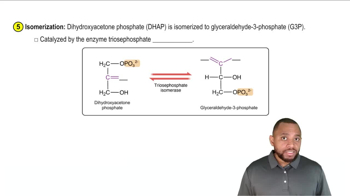
Glycolysis

Glycolysis is a metabolic pathway that converts glucose into pyruvate, producing energy in the form of ATP and NADH. It occurs in the cytoplasm of cells and consists of ten enzymatic reactions, divided into two phases: the energy investment phase and the energy payoff phase. Understanding glycolysis is essential for analyzing energy production in cellular respiration.
추천 영상:
가이드 코스
1:26
Glycolysis Concept 5

Phosphoenolpyruvate (PEP)

Phosphoenolpyruvate (PEP) is a high-energy intermediate in glycolysis, formed from 2-phosphoglycerate. It plays a crucial role in the final step of glycolysis, where it is converted to pyruvate by the enzyme pyruvate kinase. This reaction is significant because it generates ATP through substrate-level phosphorylation, contributing to the overall energy yield of glycolysis.
추천 영상:
가이드 코스
1:31
Glycolysis Example 4

ATP and NADH Production

During glycolysis, ATP and NADH are produced through various reactions. Specifically, the conversion of phosphoenolpyruvate to pyruvate generates one ATP molecule via substrate-level phosphorylation. Additionally, glycolysis produces two NADH molecules per glucose molecule, which are crucial for further energy production in aerobic respiration.
추천 영상:
가이드 코스
2:20
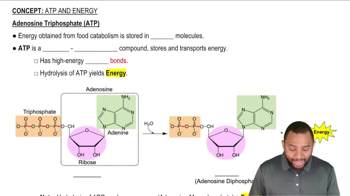
Adenosine Triphosphate (ATP) Concept 2