Ch.18 Metabolic Pathways and ATP Production
Timberlake - Chemistry: An Introduction to General, Organic, and Biological Chemistry 14th Edition
Timberlake14th EditionChemistry: An Introduction to General, Organic, and Biological ChemistryISBN: 9781292472249당신이 사용하는 게 아니라요?교과서 변경
18장, 문제 37a

Identify the reaction(s) of the citric acid cycle that involve(s)
a. oxidation and decarboxylation

검증된 단계별 안내
1
Step 1: Understand the citric acid cycle (also known as the Krebs cycle or TCA cycle). It is a series of chemical reactions used by aerobic organisms to generate energy through the oxidation of acetyl-CoA. Key reactions involve oxidation (loss of electrons) and decarboxylation (removal of a carbon atom as CO₂).
Step 2: Identify the reactions in the citric acid cycle where oxidation occurs. Oxidation reactions are typically coupled with the reduction of electron carriers such as NAD⁺ to NADH or FAD to FADH₂. Look for enzymes like dehydrogenases that catalyze these reactions.
Step 3: Identify the reactions in the citric acid cycle where decarboxylation occurs. Decarboxylation involves the removal of a carbon atom in the form of CO₂. These reactions are often catalyzed by enzymes such as decarboxylases or dehydrogenases.
Step 4: Combine the two criteria (oxidation and decarboxylation) to pinpoint the specific reactions. In the citric acid cycle, these are the steps where both oxidation and decarboxylation occur simultaneously. For example, the conversion of isocitrate to α-ketoglutarate and the conversion of α-ketoglutarate to succinyl-CoA.
Step 5: Summarize the findings. The reactions involving both oxidation and decarboxylation are catalyzed by isocitrate dehydrogenase (producing NADH and CO₂) and α-ketoglutarate dehydrogenase (producing NADH and CO₂). These steps are critical for energy production and carbon removal in the cycle.

비슷한 문제에 대한 검증된 영상 답변:

이 영상 해법은 위 문제에 도움이 된다고 튜터들이 추천한 것입니다.
영상 길이:
1m
도움이 되었나요?

주요 개념

질문에 올바르게 답하기 위해 반드시 이해해야 하는 핵심 개념들은 다음과 같습니다.

Citric Acid Cycle

The citric acid cycle, also known as the Krebs cycle, is a series of enzymatic reactions that occur in the mitochondria of cells. It plays a crucial role in cellular respiration by oxidizing acetyl-CoA to produce energy in the form of ATP, as well as electron carriers like NADH and FADH2. The cycle is essential for the metabolism of carbohydrates, fats, and proteins.
추천 영상:
가이드 코스
2:31
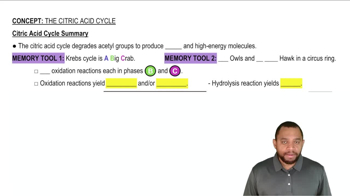
Citric Acid Cycle Summary Concept 12

Oxidation

Oxidation is a chemical process that involves the loss of electrons from a molecule, which often results in an increase in oxidation state. In the context of the citric acid cycle, oxidation reactions are vital for converting substrates into energy-rich molecules. For example, the conversion of isocitrate to alpha-ketoglutarate involves the oxidation of isocitrate, leading to the reduction of NAD+ to NADH.

Decarboxylation

Decarboxylation is the process of removing a carboxyl group from a molecule, releasing carbon dioxide (CO2) as a byproduct. In the citric acid cycle, decarboxylation occurs during specific steps, such as the conversion of alpha-ketoglutarate to succinyl-CoA. This reaction not only helps in the breakdown of carbon skeletons but also contributes to the overall energy yield of the cycle.
추천 영상:
가이드 코스
2:21
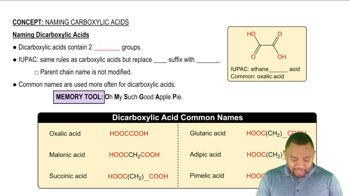
Naming Dicarboxylic Acids Concept 3