Ch.2 Chemistry and Measurements
Timberlake - Chemistry: An Introduction to General, Organic, and Biological Chemistry 14th Edition
Timberlake14th EditionChemistry: An Introduction to General, Organic, and Biological ChemistryISBN: 9781292472249당신이 사용하는 게 아니라요?교과서 변경
2장, 문제 40d

Use a prefix to write the name for each of the following:
d. 10-12 m

검증된 단계별 안내
1
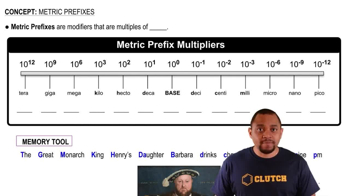
Identify the prefix that corresponds to the factor 10⁻¹². In the International System of Units (SI), the prefix for 10⁻¹² is 'pico-' (symbol: p).
Combine the prefix 'pico-' with the base unit 'meter' (m) to form the name of the measurement.
The resulting name for 10⁻¹² m is 'picometer'.

비슷한 문제에 대한 검증된 영상 답변:

이 영상 해법은 위 문제에 도움이 된다고 튜터들이 추천한 것입니다.
영상 길이:
2m

주요 개념

질문에 올바르게 답하기 위해 반드시 이해해야 하는 핵심 개념들은 다음과 같습니다.

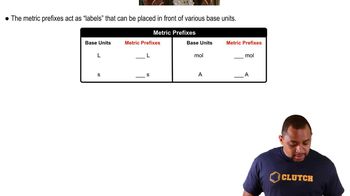
Prefix System in the Metric System

The metric system uses a series of prefixes to denote different powers of ten, making it easier to express large or small quantities. Each prefix corresponds to a specific factor, allowing for straightforward conversions and comparisons. For example, 'milli-' represents 10⁻³, while 'pico-' represents 10⁻¹².
추천 영상:
가이드 코스
01:16
Metric Prefixes

Pico

The prefix 'pico-' is used in the metric system to denote a factor of 10⁻¹², or one trillionth. It is commonly used in scientific contexts, such as measuring wavelengths of light or electrical charge, where extremely small quantities are involved. For instance, 1 picometer (pm) equals 10⁻¹² meters.
추천 영상:
가이드 코스
03:59
Metric Prefixes

Scientific Notation

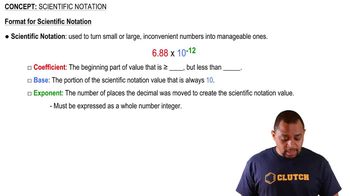
Scientific notation is a method of expressing numbers that are too large or too small in a more manageable form. It involves writing numbers as a product of a coefficient and a power of ten. For example, 10⁻¹² can be expressed as 1 x 10⁻¹², which simplifies calculations and comparisons in scientific work.
추천 영상:
가이드 코스
01:41
Scientific Notation