Ch.3 Matter and Energy
Timberlake - Chemistry: An Introduction to General, Organic, and Biological Chemistry 14th Edition
Timberlake14th EditionChemistry: An Introduction to General, Organic, and Biological ChemistryISBN: 9781292472249당신이 사용하는 게 아니라요?교과서 변경
3장, 문제 46d

Identify each of the following changes of state as melting, freezing, sublimation, or deposition:
d. Frost (ice) forms on the walls of a freezer unit of a refrigerator.

검증된 단계별 안내
1
Step 1: Understand the process described in the problem. Frost forming on the walls of a freezer involves water vapor in the air turning directly into solid ice without becoming liquid first.
Step 2: Recall the definition of deposition. Deposition is the phase change where a substance transitions directly from the gas phase to the solid phase, bypassing the liquid phase.
Step 3: Compare the described process to the definition of deposition. Since water vapor (gas) is turning into ice (solid) directly, this matches the definition of deposition.
Step 4: Confirm that no intermediate liquid phase is involved. The problem explicitly describes frost forming directly from water vapor, which is characteristic of deposition.
Step 5: Conclude that the change of state described in the problem is deposition.

비슷한 문제에 대한 검증된 영상 답변:

이 영상 해법은 위 문제에 도움이 된다고 튜터들이 추천한 것입니다.
영상 길이:
1m
도움이 되었나요?

주요 개념

질문에 올바르게 답하기 위해 반드시 이해해야 하는 핵심 개념들은 다음과 같습니다.

Deposition

Deposition is the process in which a gas transforms directly into a solid without passing through the liquid state. This occurs when the temperature and pressure conditions favor the solid phase, leading to the formation of solid particles from vapor. An example of deposition is the formation of frost on surfaces, where water vapor in the air freezes directly into ice.
추천 영상:
가이드 코스
1:50
Tollens' Test Concept 2

Phase Changes

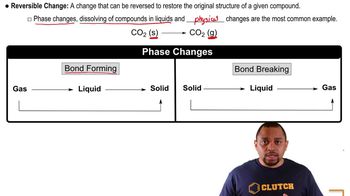
Phase changes refer to the transitions between different states of matter: solid, liquid, and gas. These changes occur due to variations in temperature and pressure, affecting the energy and arrangement of particles. Understanding phase changes is crucial for identifying processes like melting, freezing, sublimation, and deposition, as they describe how substances behave under different conditions.
추천 영상:
가이드 코스
03:40
Physical & Chemical Changes

Thermodynamics

Thermodynamics is the branch of physics that deals with heat, work, and energy transfer. It provides the principles governing phase changes, including the energy required for a substance to change from one state to another. In the context of deposition, thermodynamic principles explain how energy loss from water vapor leads to the formation of frost when it cools and solidifies on surfaces.
추천 영상:
가이드 코스
01:18
First Law of Thermodynamics