Ch.3 Matter and Energy
Timberlake - Chemistry: An Introduction to General, Organic, and Biological Chemistry 14th Edition
Timberlake14th EditionChemistry: An Introduction to General, Organic, and Biological ChemistryISBN: 9781292472249당신이 사용하는 게 아니라요?교과서 변경
3장, 문제 89

On a hot day, the beach sand gets hot but the water stays cool. Would you predict that the specific heat of sand is higher or lower than that of water? Explain.
<IMAGE>

검증된 단계별 안내
1
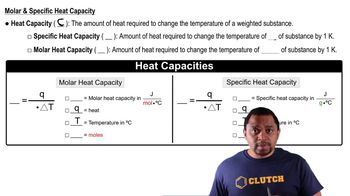
Understand the concept of specific heat: Specific heat is the amount of heat energy required to raise the temperature of 1 gram of a substance by 1°C. Substances with a high specific heat require more energy to change their temperature, while substances with a low specific heat require less energy.
Analyze the scenario: On a hot day, the sand heats up quickly, while the water remains relatively cool. This indicates that the sand's temperature changes more rapidly than the water's temperature when exposed to the same amount of heat energy.
Relate the observation to specific heat: A substance that heats up quickly with less energy input has a lower specific heat. Conversely, a substance that resists temperature change and stays cool has a higher specific heat.
Apply the concept to the problem: Since the sand heats up quickly, it must have a lower specific heat compared to water. Water, which remains cool, has a higher specific heat, meaning it requires more energy to increase its temperature.
Conclude the prediction: Based on the observations and the concept of specific heat, the specific heat of sand is lower than that of water.

비슷한 문제에 대한 검증된 영상 답변:

이 영상 해법은 위 문제에 도움이 된다고 튜터들이 추천한 것입니다.
영상 길이:
3m

주요 개념

질문에 올바르게 답하기 위해 반드시 이해해야 하는 핵심 개념들은 다음과 같습니다.

Specific Heat Capacity

Specific heat capacity is the amount of heat energy required to raise the temperature of a unit mass of a substance by one degree Celsius. It is a crucial property that determines how substances respond to heat. Materials with high specific heat can absorb more heat without a significant change in temperature, while those with low specific heat heat up quickly.
추천 영상:

Thermal Conductivity

Thermal conductivity refers to a material's ability to conduct heat. It influences how quickly heat is transferred through a substance. In the context of sand and water, sand has lower thermal conductivity compared to water, which means it heats up faster when exposed to sunlight, while water remains cooler due to its higher specific heat capacity.
추천 영상:
가이드 코스
02:13
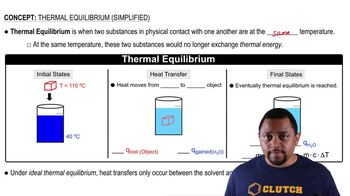
Thermal Equilibrium (Simplified) Concept 1

Heat Transfer

Heat transfer is the process of thermal energy moving from one object or substance to another. It occurs through conduction, convection, or radiation. On a hot day, the sun heats the sand directly, causing it to reach higher temperatures quickly, while the water, with its higher specific heat, absorbs heat more slowly, resulting in a cooler temperature.
추천 영상: