Ch.4 Atoms and Elements
Timberlake - Chemistry: An Introduction to General, Organic, and Biological Chemistry 14th Edition
Timberlake14th EditionChemistry: An Introduction to General, Organic, and Biological ChemistryISBN: 9781292472249당신이 사용하는 게 아니라요?교과서 변경
4장, 문제 44

Indium consists of two isotopes, 11349In and 11549In. If the atomic mass for indium on the periodic table is 114.8, are there more atoms of 11349In or 11549In in a sample of indium?

검증된 단계별 안내
1
Step 1: Understand the problem. The atomic mass of indium on the periodic table is a weighted average of the masses of its isotopes, ¹¹³₄₉In and ¹¹⁵₄₉In. The goal is to determine which isotope is more abundant in a sample of indium based on the given atomic mass (114.8).
Step 2: Recall the formula for calculating the weighted average atomic mass: \( \text{Atomic Mass} = (\text{Fraction of Isotope 1} \times \text{Mass of Isotope 1}) + (\text{Fraction of Isotope 2} \times \text{Mass of Isotope 2}) \). Here, the fractions represent the relative abundances of the isotopes.
Step 3: Compare the given atomic mass (114.8) to the masses of the isotopes. The atomic mass is closer to 115 than to 113, which suggests that the isotope ¹¹⁵₄₉In is more abundant than ¹¹³₄₉In.
Step 4: To confirm this, set up a system of equations using the weighted average formula. Let \( x \) represent the fraction of ¹¹³₄₉In and \( 1 - x \) represent the fraction of ¹¹⁵₄₉In. Substitute the values into the formula: \( 114.8 = (x \times 113) + ((1 - x) \times 115) \).
Step 5: Solve the equation for \( x \) to determine the relative abundances of the isotopes. The value of \( x \) will indicate the fraction of ¹¹³₄₉In, and \( 1 - x \) will indicate the fraction of ¹¹⁵₄₉In. Based on the comparison in Step 3, expect \( x \) to be less than 0.5, confirming that ¹¹⁵₄₉In is more abundant.

비슷한 문제에 대한 검증된 영상 답변:

이 영상 해법은 위 문제에 도움이 된다고 튜터들이 추천한 것입니다.
영상 길이:
1m
도움이 되었나요?

주요 개념

질문에 올바르게 답하기 위해 반드시 이해해야 하는 핵심 개념들은 다음과 같습니다.

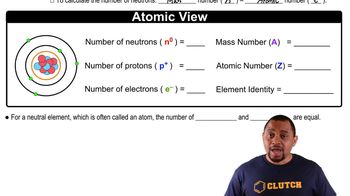
Isotopes

Isotopes are variants of a chemical element that have the same number of protons but different numbers of neutrons, resulting in different atomic masses. For indium, the isotopes ¹¹³₄₉In and ¹¹⁵₄₉In have atomic masses of 113 and 115, respectively. Understanding isotopes is crucial for analyzing the composition of elements and their relative abundances in a sample.
추천 영상:

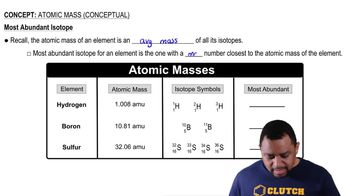
Atomic Mass

Atomic mass is the weighted average mass of an element's isotopes, measured in atomic mass units (amu). The atomic mass of indium is given as 114.8, which indicates that the average mass of indium atoms in a sample is influenced by the relative abundances of its isotopes. This concept is essential for determining the ratio of isotopes present in a sample.
추천 영상:
가이드 코스
02:49
Atomic Mass (Conceptual) Concept 2

Relative Abundance

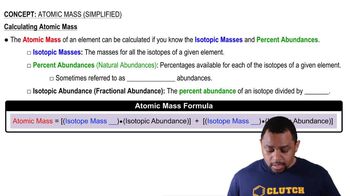
Relative abundance refers to the proportion of each isotope of an element present in a sample. It can be calculated using the atomic mass and the masses of the individual isotopes. In the case of indium, knowing the atomic mass allows us to infer whether there are more atoms of ¹¹³₄₉In or ¹¹⁵₄₉In based on their contributions to the average atomic mass.
추천 영상:
가이드 코스
01:51
Atomic Mass (Simplified) Concept 2