Ch.4 Atoms and Elements
Timberlake - Chemistry: An Introduction to General, Organic, and Biological Chemistry 14th Edition
Timberlake14th EditionChemistry: An Introduction to General, Organic, and Biological ChemistryISBN: 9781292472249당신이 사용하는 게 아니라요?교과서 변경
4장, 문제 27c

Would you use the atomic number, mass number, or both to determine each of the following?
c. number of particles in the nucleus

검증된 단계별 안내
1
Understand the composition of the nucleus: The nucleus of an atom contains protons and neutrons. The atomic number represents the number of protons, while the mass number represents the total number of protons and neutrons.
Recall the definition of atomic number: The atomic number is the number of protons in the nucleus of an atom. It is unique to each element and does not include neutrons.
Recall the definition of mass number: The mass number is the sum of the protons and neutrons in the nucleus. It provides the total count of particles in the nucleus.
Determine which value is needed: To find the total number of particles in the nucleus, you need the mass number because it accounts for both protons and neutrons.
Conclude that the atomic number alone is insufficient: While the atomic number gives the number of protons, it does not include neutrons. Therefore, the mass number is required to determine the total number of particles in the nucleus.

비슷한 문제에 대한 검증된 영상 답변:

이 영상 해법은 위 문제에 도움이 된다고 튜터들이 추천한 것입니다.
영상 길이:
50s
도움이 되었나요?

주요 개념

질문에 올바르게 답하기 위해 반드시 이해해야 하는 핵심 개념들은 다음과 같습니다.

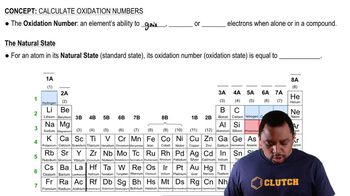
Atomic Number

The atomic number is the number of protons in the nucleus of an atom, which defines the element and its position on the periodic table. It also indicates the number of electrons in a neutral atom, influencing its chemical properties. Understanding the atomic number is essential for identifying the type of element and its behavior in reactions.
추천 영상:
가이드 코스
02:42
Calculate Oxidation Numbers

Mass Number

The mass number is the total number of protons and neutrons in an atom's nucleus. It provides insight into the atom's overall mass and stability, as isotopes of an element differ in their neutron count. The mass number is crucial for understanding nuclear properties and the behavior of isotopes in various applications.
추천 영상:
가이드 코스
01:21
Mass Percent Example

Nucleus Composition

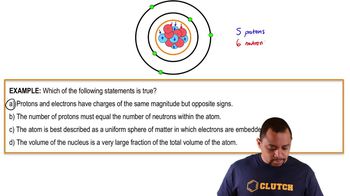
The nucleus of an atom is composed of protons and neutrons, collectively known as nucleons. The number of particles in the nucleus can be determined by the mass number, as it accounts for both protons and neutrons. This concept is fundamental for understanding atomic structure and the forces that hold the nucleus together.
추천 영상:
가이드 코스
02:52
The Atom (Simplified) Example 1