Ch.5 Nuclear Chemistry
Timberlake - Chemistry: An Introduction to General, Organic, and Biological Chemistry 14th Edition
Timberlake14th EditionChemistry: An Introduction to General, Organic, and Biological ChemistryISBN: 9781292472249당신이 사용하는 게 아니라요?교과서 변경
5장, 문제 20e

Complete each of the following nuclear equations and describe the type of radiation:
e. ? → 8939Y + 0+1e

검증된 단계별 안내
1
Step 1: Understand the problem. The equation involves a nuclear reaction where an unknown nucleus decays into ⁸⁹₃₉Y (yttrium-89) and a ⁰₊₁e particle (a positron). The goal is to determine the missing nucleus and identify the type of radiation involved.
Step 2: Recall the law of conservation of mass number and atomic number. In nuclear reactions, the sum of the mass numbers (superscripts) and the sum of the atomic numbers (subscripts) must be equal on both sides of the equation.
Step 3: Apply the conservation of mass number. The mass number of the unknown nucleus must equal the sum of the mass numbers of the products. Since ⁸⁹₃₉Y has a mass number of 89 and ⁰₊₁e has a mass number of 0, the mass number of the unknown nucleus is 89.
Step 4: Apply the conservation of atomic number. The atomic number of the unknown nucleus must equal the sum of the atomic numbers of the products. Since ⁸⁹₃₉Y has an atomic number of 39 and ⁰₊₁e has an atomic number of +1, the atomic number of the unknown nucleus is 39 + 1 = 40.
Step 5: Identify the unknown nucleus and the type of radiation. The element with atomic number 40 is zirconium (Zr). Therefore, the missing nucleus is ⁸⁹₄₀Zr. The emission of a ⁰₊₁e particle indicates positron emission, which is a type of beta radiation.

비슷한 문제에 대한 검증된 영상 답변:

이 영상 해법은 위 문제에 도움이 된다고 튜터들이 추천한 것입니다.
영상 길이:
1m

주요 개념

질문에 올바르게 답하기 위해 반드시 이해해야 하는 핵심 개념들은 다음과 같습니다.

Nuclear Equations

Nuclear equations represent the transformation of one element into another through radioactive decay or nuclear reactions. They show the reactants and products, including atomic numbers and mass numbers, which must be balanced. Understanding how to complete these equations is essential for identifying the type of radiation emitted during the process.
추천 영상:
가이드 코스
01:13
Thermochemical Equations

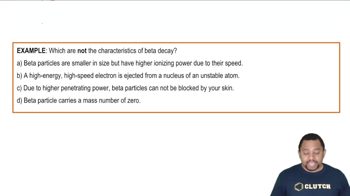
Beta Decay

Beta decay is a type of radioactive decay in which a neutron in an unstable nucleus is transformed into a proton, emitting a beta particle (an electron or positron) in the process. This increases the atomic number of the element by one while keeping the mass number the same. Recognizing beta decay is crucial for completing the given nuclear equation.
추천 영상:
가이드 코스
01:02
Characteristics of Beta Particles Example

Radiation Types

Radiation types include alpha particles, beta particles, and gamma rays, each with distinct properties and effects. Alpha particles consist of two protons and two neutrons, beta particles are high-energy electrons or positrons, and gamma rays are electromagnetic radiation. Identifying the type of radiation helps in understanding the nature of the nuclear reaction and its implications.
추천 영상:
가이드 코스
01:08
Nuclear vs Chemical Reactions