Ch.5 Nuclear Chemistry
Timberlake - Chemistry: An Introduction to General, Organic, and Biological Chemistry 14th Edition
Timberlake14th EditionChemistry: An Introduction to General, Organic, and Biological ChemistryISBN: 9781292472249당신이 사용하는 게 아니라요?교과서 변경
5장, 문제 53

In problems 5.51 to 5.54, a nucleus is shown with protons and neutrons.
Draw the nucleus of the isotope that is bombarded in the following:
<IMAGE>

검증된 단계별 안내
1
Step 1: Analyze the image provided. The first image shows a nucleus being bombarded with a particle (composed of two neutrons and two protons, resembling an alpha particle). The result is a new isotope nucleus and an emitted particle.
Step 2: Identify the components of the nucleus before the bombardment. Count the number of protons (orange spheres) and neutrons (black spheres) in the nucleus of the new isotope shown in the image. This will help deduce the original nucleus before the bombardment.
Step 3: Use the conservation of nucleons (protons + neutrons) to determine the original nucleus. The total number of protons and neutrons in the original nucleus plus the bombarding particle must equal the total number of protons and neutrons in the new isotope nucleus and the emitted particle.
Step 4: Write the nuclear reaction equation. Represent the original nucleus, the bombarding particle, the new isotope nucleus, and the emitted particle using their respective atomic symbols and mass numbers. Ensure the equation is balanced in terms of both mass number and atomic number.
Step 5: Draw the nucleus of the original isotope before bombardment. Based on the calculations and analysis, depict the nucleus with the correct number of protons and neutrons using the color scheme provided in the second image (orange for protons and black for neutrons).

비슷한 문제에 대한 검증된 영상 답변:

이 영상 해법은 위 문제에 도움이 된다고 튜터들이 추천한 것입니다.
영상 길이:
9m
도움이 되었나요?

주요 개념

질문에 올바르게 답하기 위해 반드시 이해해야 하는 핵심 개념들은 다음과 같습니다.

Nuclear Structure

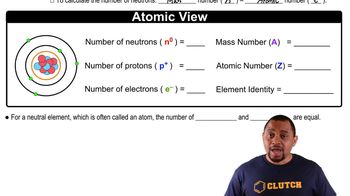
The nucleus of an atom is composed of protons and neutrons, collectively known as nucleons. Protons carry a positive charge, while neutrons are neutral. The number of protons determines the element, while the total number of protons and neutrons defines the isotope. Understanding the arrangement and number of these particles is crucial for analyzing nuclear reactions and isotopes.
추천 영상:
가이드 코스
1:01
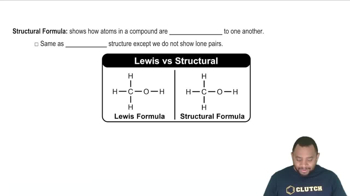
Structural Formula Concept 2

Isotopes

Isotopes are variants of a particular chemical element that have the same number of protons but different numbers of neutrons. This difference in neutron count results in varying atomic masses. Isotopes can be stable or unstable, with unstable isotopes undergoing radioactive decay. Recognizing isotopes is essential in nuclear chemistry, especially when predicting the outcomes of nuclear reactions.
추천 영상:

Nuclear Reactions

Nuclear reactions involve changes in an atom's nucleus and can result in the formation of new isotopes. These reactions can occur through processes such as bombardment, where particles like neutrons or protons collide with a nucleus, leading to the emission of other particles and the transformation of the original nucleus. Understanding the mechanics of these reactions is vital for predicting the products formed in nuclear chemistry.
추천 영상:
가이드 코스
1:30
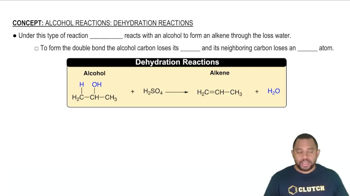
Alcohol Reactions: Dehydration Reactions Concept 1