Ch.5 Nuclear Chemistry
Timberlake - Chemistry: An Introduction to General, Organic, and Biological Chemistry 14th Edition
Timberlake14th EditionChemistry: An Introduction to General, Organic, and Biological ChemistryISBN: 9781292472249당신이 사용하는 게 아니라요?교과서 변경
5장, 문제 10

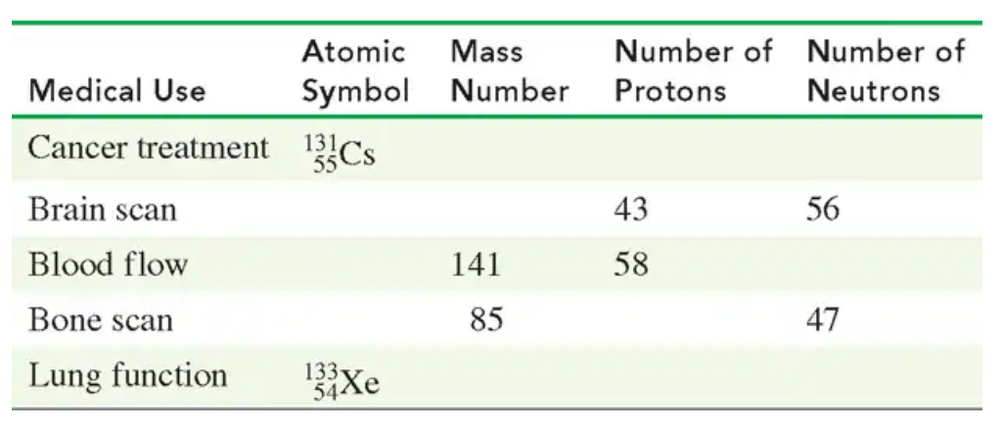
Supply the missing information in the following table:
Table displaying medical uses of isotopes, including atomic symbols, mass numbers, protons, and neutrons.

검증된 단계별 안내
1
Step 1: Identify the atomic number from the isotopic symbol. The atomic number is the subscript (lower left number) in the isotopic symbol, which represents the number of protons in the nucleus. For 198^79Au, the atomic number is 79.
Step 2: Determine the mass number from the isotopic symbol. The mass number is the superscript (upper left number) in the isotopic symbol, which represents the total number of protons and neutrons in the nucleus. For 198^79Au, the mass number is 198.
Step 3: Calculate the number of protons. The number of protons is equal to the atomic number. For 198^79Au, the number of protons is 79.
Step 4: Calculate the number of neutrons. The number of neutrons can be found by subtracting the atomic number (number of protons) from the mass number: \( \text{Number of neutrons} = \text{Mass number} - \text{Atomic number} \). For 198^79Au, \( \text{Number of neutrons} = 198 - 79 \).
Step 5: Fill in the missing information in the table based on the calculations: Atomic Number = 79, Mass Number = 198, Number of Protons = 79, Number of Neutrons = (198 - 79).

비슷한 문제에 대한 검증된 영상 답변:

이 영상 해법은 위 문제에 도움이 된다고 튜터들이 추천한 것입니다.
영상 길이:
1m
도움이 되었나요?

주요 개념

질문에 올바르게 답하기 위해 반드시 이해해야 하는 핵심 개념들은 다음과 같습니다.

Isotopic Symbol

The isotopic symbol represents a specific isotope of an element, denoted by the element's chemical symbol along with its mass number as a superscript and atomic number as a subscript. For example, in the symbol 19879Au, 'Au' stands for gold, '79' is the atomic number indicating the number of protons, and '198' is the mass number, which is the total number of protons and neutrons.
추천 영상:
가이드 코스
03:57
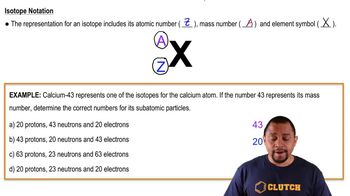
Isotopes Example 1

Atomic Number

The atomic number is a fundamental property of an element that defines its identity, representing the number of protons in the nucleus of an atom. It determines the element's position in the periodic table and its chemical behavior. For instance, gold (Au) has an atomic number of 79, meaning it has 79 protons and, in a neutral atom, also 79 electrons.
추천 영상:
가이드 코스
02:42
Calculate Oxidation Numbers

Mass Number and Neutrons

The mass number is the sum of protons and neutrons in an atom's nucleus, providing a measure of the atom's total mass. To find the number of neutrons, subtract the atomic number from the mass number. For example, for the isotope 19879Au, the mass number is 198, and with an atomic number of 79, the number of neutrons is 198 - 79 = 119.
추천 영상:
가이드 코스
01:21
Mass Percent Example