Ch.5 Nuclear Chemistry
Timberlake - Chemistry: An Introduction to General, Organic, and Biological Chemistry 14th Edition
Timberlake14th EditionChemistry: An Introduction to General, Organic, and Biological ChemistryISBN: 9781292472249당신이 사용하는 게 아니라요?교과서 변경
5장, 문제 88

The half-life for the radioactive decay of Ce-141 is 32.5 days. If a sample has an activity of 4.0 µCi after 130 days have elapsed, what was the initial activity, in microcuries, of the sample?

검증된 단계별 안내
1
Understand the problem: The half-life of Ce-141 is 32.5 days, and the activity of the sample after 130 days is 4.0 µCi. We need to calculate the initial activity of the sample using the radioactive decay formula.
Use the radioactive decay formula: \( A = A_0 \cdot e^{-kt} \), where \( A \) is the activity at time \( t \), \( A_0 \) is the initial activity, \( k \) is the decay constant, and \( t \) is the elapsed time.
Calculate the decay constant \( k \) using the relationship between half-life and \( k \): \( k = \frac{\ln(2)}{t_{1/2}} \). Substitute \( t_{1/2} = 32.5 \; \text{days} \) into the equation to find \( k \).
Rearrange the decay formula to solve for \( A_0 \): \( A_0 = \frac{A}{e^{-kt}} \). Substitute \( A = 4.0 \; \mu\text{Ci} \), \( k \) (calculated in the previous step), and \( t = 130 \; \text{days} \) into the equation.
Simplify the expression to calculate \( A_0 \), which represents the initial activity of the sample in microcuries.

비슷한 문제에 대한 검증된 영상 답변:

이 영상 해법은 위 문제에 도움이 된다고 튜터들이 추천한 것입니다.
영상 길이:
4m

주요 개념

질문에 올바르게 답하기 위해 반드시 이해해야 하는 핵심 개념들은 다음과 같습니다.

Half-Life

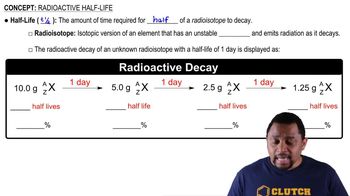
Half-life is the time required for half of the radioactive nuclei in a sample to decay. It is a crucial concept in understanding radioactive decay processes, as it allows us to predict how long it will take for a given amount of a radioactive substance to reduce to a specific fraction of its original quantity. In this case, the half-life of Ce-141 is 32.5 days.
추천 영상:
가이드 코스
02:09
Radioactive Half-Life Concept 1

Radioactive Decay

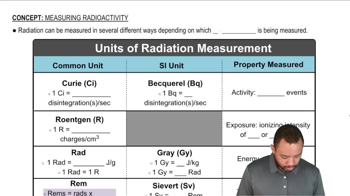
Radioactive decay is the process by which an unstable atomic nucleus loses energy by emitting radiation. This process results in the transformation of the original element into a different element or isotope. The activity of a radioactive sample, measured in microcuries (µCi), indicates the rate of decay and is directly related to the number of radioactive atoms present in the sample.
추천 영상:
가이드 코스
02:52
Measuring Radioactivity Concept 1

Exponential Decay Formula

The exponential decay formula describes how the quantity of a radioactive substance decreases over time. It is expressed as N(t) = N0 * (1/2)^(t/T), where N(t) is the remaining quantity at time t, N0 is the initial quantity, and T is the half-life. This formula is essential for calculating the initial activity of the sample based on the activity observed after a certain period, allowing for the determination of how much of the substance has decayed.
추천 영상:
가이드 코스
01:02
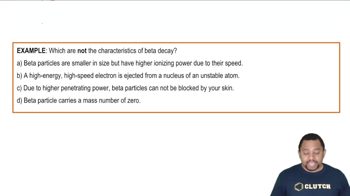
Characteristics of Beta Particles Example