Ch.5 Nuclear Chemistry
Timberlake - Chemistry: An Introduction to General, Organic, and Biological Chemistry 14th Edition
Timberlake14th EditionChemistry: An Introduction to General, Organic, and Biological ChemistryISBN: 9781292472249당신이 사용하는 게 아니라요?교과서 변경
5장, 문제 26

Two samples of a radioisotope were spilled in a nuclear laboratory. The activity of one sample was 8 kBq and the other 15 mCi. Which sample produced the higher amount of radiation?

검증된 단계별 안내
1
Understand the problem: The activity of the two samples is given in different units (kBq and mCi). To compare them, we need to convert both activities into the same unit.
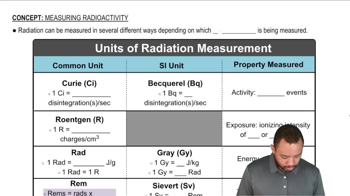
Recall the unit conversion factors: 1 Ci (Curie) = 3.7 × 10^10 Bq (Becquerel). Therefore, 1 mCi (millicurie) = 3.7 × 10^7 Bq.
Convert the activity of the second sample from mCi to Bq using the formula: \( \text{Activity in Bq} = \text{Activity in mCi} imes 3.7 imes 10^7 \). Substitute 15 mCi into the formula.
Compare the activity of the first sample (8 kBq, which is \( 8 imes 10^3 \) Bq) with the converted activity of the second sample in Bq.
Determine which sample has the higher activity based on the comparison of the two values in Bq.

비슷한 문제에 대한 검증된 영상 답변:

이 영상 해법은 위 문제에 도움이 된다고 튜터들이 추천한 것입니다.
영상 길이:
1m
도움이 되었나요?

주요 개념

질문에 올바르게 답하기 위해 반드시 이해해야 하는 핵심 개념들은 다음과 같습니다.

Radioactivity

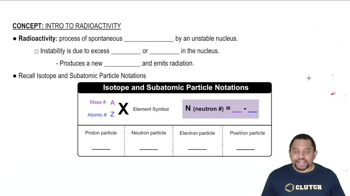
Radioactivity is the process by which unstable atomic nuclei lose energy by emitting radiation. This can occur in the form of alpha particles, beta particles, or gamma rays. The rate of decay is measured in terms of activity, which indicates how many disintegrations occur per unit time, typically expressed in becquerels (Bq) or curies (Ci). Understanding radioactivity is essential for comparing the radiation emitted by different samples.
추천 영상:
가이드 코스
02:52
Measuring Radioactivity Concept 1

Units of Measurement

Radioactivity is measured in various units, with the becquerel (Bq) and curie (Ci) being the most common. One becquerel corresponds to one disintegration per second, while one curie is equivalent to 37 billion disintegrations per second. To compare the activity of the two samples effectively, it is crucial to convert them into the same unit, allowing for a direct comparison of their radiation output.
추천 영상:
가이드 코스
02:52
Measuring Radioactivity Concept 1

Radiation Dose

Radiation dose refers to the amount of radiation energy absorbed by a material or biological tissue. It is important to understand that higher activity levels in radioisotopes can lead to greater radiation doses, which can have significant health implications. By analyzing the activity of the samples, one can determine which sample poses a greater risk in terms of radiation exposure.
추천 영상:
가이드 코스
02:29
Intro to Radioactivity