

Ch.6 Ionic and Molecular Compounds
Timberlake - Chemistry: An Introduction to General, Organic, and Biological Chemistry 14th Edition
Timberlake14th EditionChemistry: An Introduction to General, Organic, and Biological ChemistryISBN: 9781292472249당신이 사용하는 게 아니라요?교과서 변경
6장, 문제 105d

Consider the following bonds: Ca and O, C and O, K and O, O and O, and N and O.
d. Arrange the covalent bonds in order of decreasing polarity.

검증된 단계별 안내
1
Identify the concept of bond polarity: Bond polarity arises due to the difference in electronegativity between two atoms. The greater the difference in electronegativity, the more polar the bond.
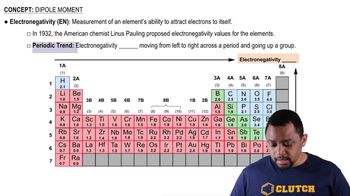
Determine the electronegativity values of the elements involved: Use the periodic table to find the electronegativity values for calcium (Ca), carbon (C), oxygen (O), potassium (K), and nitrogen (N). For example, oxygen has a high electronegativity (~3.5), while potassium and calcium have much lower values (~0.8 and ~1.0, respectively).
Calculate the electronegativity differences for each bond: Subtract the smaller electronegativity value from the larger one for each bond. For example, for the C and O bond, the difference is |3.5 - 2.5| = 1.0.
Rank the bonds based on the electronegativity differences: Arrange the bonds in order of decreasing polarity by comparing the calculated electronegativity differences. Larger differences correspond to more polar bonds.
Exclude nonpolar bonds: If the electronegativity difference is zero (e.g., O and O bond, where both atoms are oxygen), the bond is nonpolar and should be placed at the end of the list or excluded from the ranking.

비슷한 문제에 대한 검증된 영상 답변:

이 영상 해법은 위 문제에 도움이 된다고 튜터들이 추천한 것입니다.
영상 길이:
4m
도움이 되었나요?

주요 개념

질문에 올바르게 답하기 위해 반드시 이해해야 하는 핵심 개념들은 다음과 같습니다.

Electronegativity

Electronegativity is a measure of an atom's ability to attract and hold onto electrons in a chemical bond. The difference in electronegativity between two bonded atoms determines the polarity of the bond; a larger difference indicates a more polar bond. For example, in a bond between oxygen and carbon, oxygen's higher electronegativity leads to a polar covalent bond.
추천 영상:
가이드 코스
01:51
Dipole Moment (Simplified) Concept 1

Covalent Bonding

Covalent bonding occurs when two atoms share electrons to achieve a full outer shell, resulting in a stable molecule. The nature of the bond can vary from nonpolar (equal sharing of electrons) to polar (unequal sharing), depending on the electronegativity of the atoms involved. Understanding the types of covalent bonds is essential for determining their polarity.
추천 영상:
가이드 코스
01:04
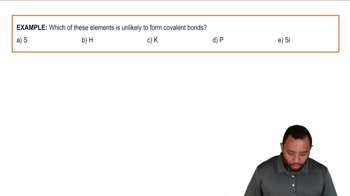
Covalent Bonds Example 1

Polarity of Bonds

The polarity of a bond refers to the distribution of electrical charge across the bond, influenced by the electronegativity of the atoms involved. Polar bonds have a significant difference in electronegativity, leading to partial positive and negative charges, while nonpolar bonds have little to no charge separation. This concept is crucial for arranging bonds by polarity, as it directly affects molecular behavior and interactions.
추천 영상:
가이드 코스
01:34
Molecular Polarity (Simplified) Concept 1