Ch.6 Ionic and Molecular Compounds
Timberlake - Chemistry: An Introduction to General, Organic, and Biological Chemistry 14th Edition
Timberlake14th EditionChemistry: An Introduction to General, Organic, and Biological ChemistryISBN: 9781292472249당신이 사용하는 게 아니라요?교과서 변경
6장, 문제 99

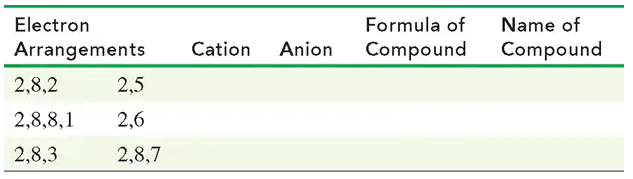
Using each of the following electron arrangements, give the formulas for the cation and anion that form, the formula for the compound they form, and its name.
Table displaying electron arrangements, cations, anions, compound formulas, and compound names for ionic compounds.

검증된 단계별 안내
1
Step 1: Understand the problem. The question asks for the cation and anion that form based on given electron arrangements, the formula of the compound they form, and the name of the compound. This involves understanding electron configurations, ion formation, and naming ionic compounds.
Step 2: Identify the cation. Examine the electron arrangement provided for the first species. Determine how many electrons are lost to achieve a stable electron configuration (usually a noble gas configuration). The resulting species is the cation, and its charge is equal to the number of electrons lost.
Step 3: Identify the anion. Examine the electron arrangement provided for the second species. Determine how many electrons are gained to achieve a stable electron configuration. The resulting species is the anion, and its charge is equal to the number of electrons gained.
Step 4: Write the formula of the compound. Combine the cation and anion in a ratio that balances the total positive and negative charges. Use subscripts to indicate the number of each ion in the compound.
Step 5: Name the compound. Use the name of the cation (usually the element name) followed by the name of the anion. For monatomic anions, the element name is modified to end in '-ide.' For polyatomic ions, use the standard name of the ion.

비슷한 문제에 대한 검증된 영상 답변:

이 영상 해법은 위 문제에 도움이 된다고 튜터들이 추천한 것입니다.
영상 길이:
3m
도움이 되었나요?

주요 개념

질문에 올바르게 답하기 위해 반드시 이해해야 하는 핵심 개념들은 다음과 같습니다.

Electron Configuration

Electron configuration describes the distribution of electrons in an atom's orbitals. It is crucial for understanding how atoms interact and bond with one another. The arrangement of electrons determines an atom's reactivity and the types of ions it can form, which is essential for predicting the formulas of cations and anions.
추천 영상:
가이드 코스
01:08
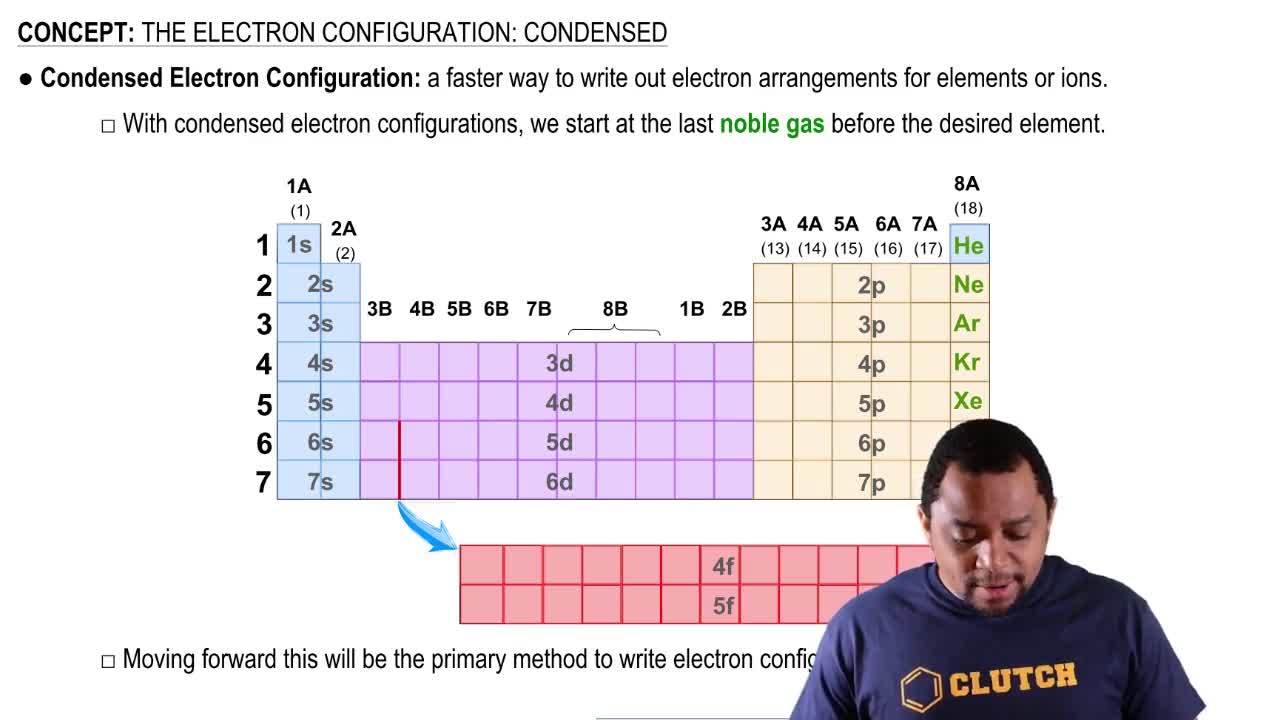
The Electron Configuration: Condensed

Ionic Compounds

Ionic compounds are formed when cations (positively charged ions) and anions (negatively charged ions) bond together through electrostatic forces. The overall charge of the compound must be neutral, which influences the ratio of cations to anions in the formula. Understanding how to derive the formula and name of an ionic compound is key to answering the question.
추천 영상:
가이드 코스
02:11
Naming Ionic Compounds

Nomenclature of Ionic Compounds

Nomenclature refers to the system of naming chemical compounds. For ionic compounds, the name typically consists of the cation name followed by the anion name, with specific rules for transition metals and polyatomic ions. Familiarity with these naming conventions is essential for accurately identifying and naming the compounds formed from the given electron arrangements.
추천 영상:
가이드 코스
02:11
Naming Ionic Compounds