Ch.6 Ionic and Molecular Compounds
Timberlake - Chemistry: An Introduction to General, Organic, and Biological Chemistry 14th Edition
Timberlake14th EditionChemistry: An Introduction to General, Organic, and Biological ChemistryISBN: 9781292472249당신이 사용하는 게 아니라요?교과서 변경
6장, 문제 80

Why is CCl4 a nonpolar molecule, but is PCl3 a polar molecule?

검증된 단계별 안내
1
Step 1: Understand the concept of molecular polarity. A molecule is polar if it has an uneven distribution of electron density, resulting in a dipole moment. This typically occurs when there are polar bonds and the molecular geometry does not cancel out the dipole moments.
Step 2: Analyze the structure of CCl₄ (carbon tetrachloride). The central carbon atom is bonded to four chlorine atoms in a tetrahedral geometry. Each C-Cl bond is polar due to the difference in electronegativity between carbon and chlorine.
Step 3: Determine the net dipole moment for CCl₄. In a tetrahedral geometry, the dipole moments of the four C-Cl bonds cancel each other out because they are symmetrically arranged around the central carbon atom. This results in a nonpolar molecule.
Step 4: Analyze the structure of PCl₃ (phosphorus trichloride). The central phosphorus atom is bonded to three chlorine atoms and has one lone pair of electrons. This gives the molecule a trigonal pyramidal geometry.
Step 5: Determine the net dipole moment for PCl₃. The lone pair on phosphorus creates an asymmetry in the electron distribution, and the dipole moments of the P-Cl bonds do not cancel out. This results in a polar molecule.

비슷한 문제에 대한 검증된 영상 답변:

이 영상 해법은 위 문제에 도움이 된다고 튜터들이 추천한 것입니다.
영상 길이:
3m
도움이 되었나요?

주요 개념

질문에 올바르게 답하기 위해 반드시 이해해야 하는 핵심 개념들은 다음과 같습니다.

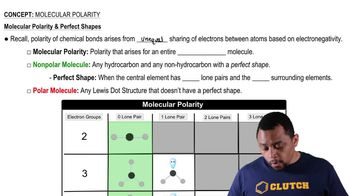
Molecular Polarity

Molecular polarity refers to the distribution of electrical charge across a molecule. It is determined by the shape of the molecule and the electronegativity of its atoms. A molecule is polar if it has a net dipole moment due to an uneven distribution of charge, while nonpolar molecules have a symmetrical charge distribution.
추천 영상:
가이드 코스
01:34
Molecular Polarity (Simplified) Concept 1

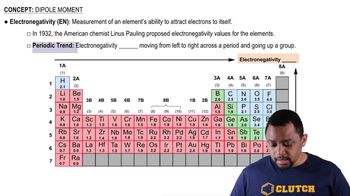
Electronegativity

Electronegativity is a measure of an atom's ability to attract and hold onto electrons in a chemical bond. In polar molecules, there is a significant difference in electronegativity between bonded atoms, leading to unequal sharing of electrons. In contrast, nonpolar molecules have atoms with similar electronegativities, resulting in equal sharing of electrons.
추천 영상:
가이드 코스
01:51
Dipole Moment (Simplified) Concept 1

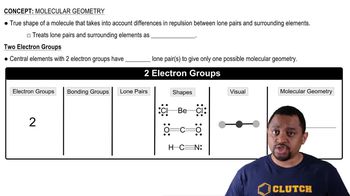
Molecular Geometry

Molecular geometry refers to the three-dimensional arrangement of atoms within a molecule. The shape of a molecule affects its polarity; for example, CCl₄ has a tetrahedral shape that allows for symmetrical charge distribution, making it nonpolar. In contrast, PCl₃ has a trigonal pyramidal shape, leading to an uneven distribution of charge and making it polar.
추천 영상:
가이드 코스
01:30
Molecular Geometry (Simplified) Concept 1