
Ch.8 Gases
Timberlake - Chemistry: An Introduction to General, Organic, and Biological Chemistry 14th Edition
Timberlake14th EditionChemistry: An Introduction to General, Organic, and Biological ChemistryISBN: 9781292472249당신이 사용하는 게 아니라요?교과서 변경
8장, 문제 28b

A solution containing 80. g of NaNO3 in 75 g of H2O at 50 °C is cooled to 20 °C. b. How many grams of solid NaNO3 crystallized after cooling?

검증된 단계별 안내
1
Step 1: Understand the solubility concept. Solubility is the maximum amount of solute that can dissolve in a given amount of solvent at a specific temperature. For NaNO₃, the solubility changes with temperature, and this information is typically provided in a solubility chart or table.
Step 2: Refer to the solubility chart for NaNO₃. Find the solubility of NaNO₃ at 50 °C and at 20 °C. For example, if the solubility at 50 °C is X g per 100 g of H₂O and at 20 °C is Y g per 100 g of H₂O, use these values for calculations.
Step 3: Calculate the amount of NaNO₃ that can dissolve in 75 g of H₂O at 50 °C. Use the proportion: \( \text{Amount of NaNO₃ dissolved} = \frac{X}{100} \times 75 \).
Step 4: Calculate the amount of NaNO₃ that can dissolve in 75 g of H₂O at 20 °C. Use the proportion: \( \text{Amount of NaNO₃ dissolved} = \frac{Y}{100} \times 75 \).
Step 5: Subtract the amount of NaNO₃ that can dissolve at 20 °C from the amount that was dissolved at 50 °C. The difference represents the mass of NaNO₃ that crystallized: \( \text{Mass crystallized} = \text{Amount dissolved at 50 °C} - \text{Amount dissolved at 20 °C} \).

비슷한 문제에 대한 검증된 영상 답변:

이 영상 해법은 위 문제에 도움이 된다고 튜터들이 추천한 것입니다.
영상 길이:
6m

주요 개념

질문에 올바르게 답하기 위해 반드시 이해해야 하는 핵심 개념들은 다음과 같습니다.

Solubility

Solubility refers to the maximum amount of a solute that can dissolve in a solvent at a given temperature. In this case, the solubility of NaNO3 in water changes with temperature, meaning that as the solution cools from 50 °C to 20 °C, the amount of NaNO3 that can remain dissolved decreases, leading to crystallization.
추천 영상:
가이드 코스
00:28
Solubility Rules

Crystallization

Crystallization is the process where dissolved solute comes out of solution and forms solid crystals. This occurs when the solution becomes supersaturated, which can happen when the temperature drops, causing excess solute to precipitate out of the solution as solid NaNO3.
추천 영상:
가이드 코스
01:46
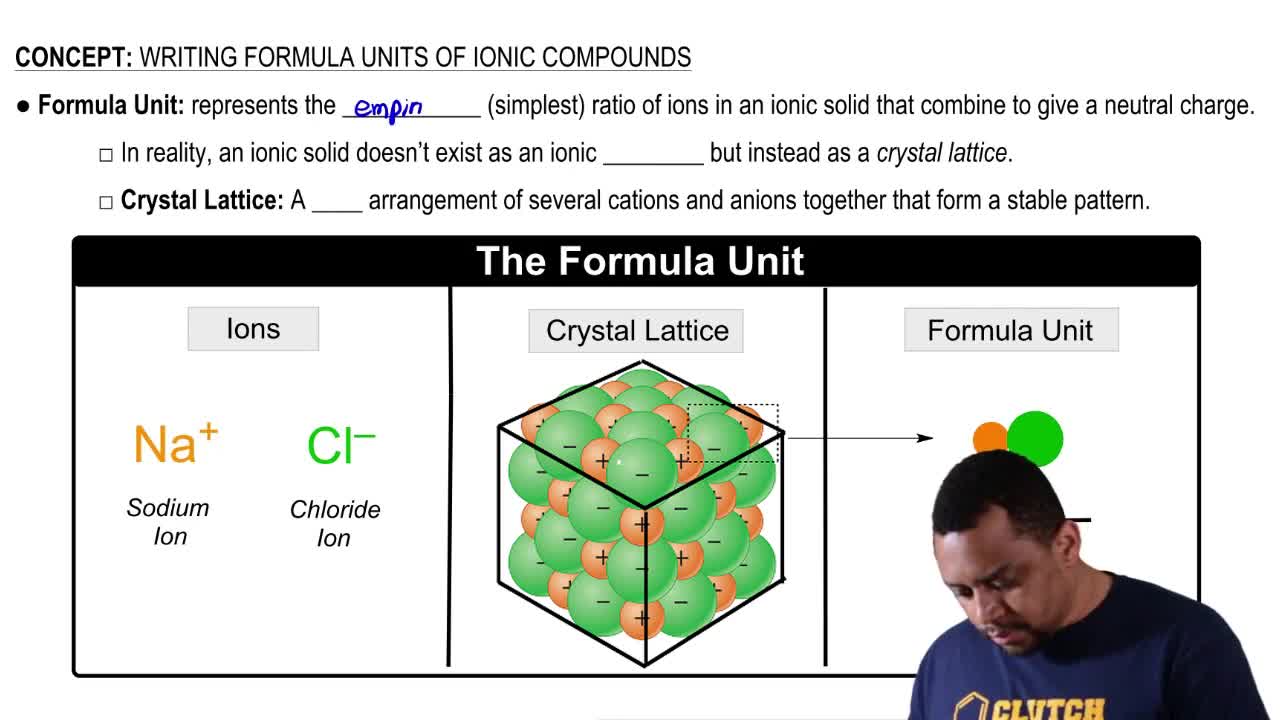
Writing Formula Units of Ionic Compounds Concept 1

Mass Balance

Mass balance is a principle used to account for the mass of substances in a system. In this scenario, it involves calculating the initial mass of NaNO3, determining how much remains dissolved at the lower temperature, and finding the difference to ascertain the mass of NaNO3 that crystallized out of the solution.
추천 영상:
가이드 코스
00:38
Mass Percent Concept