Ch.9 Solutions
Timberlake - Chemistry: An Introduction to General, Organic, and Biological Chemistry 14th Edition
Timberlake14th EditionChemistry: An Introduction to General, Organic, and Biological ChemistryISBN: 9781292472249당신이 사용하는 게 아니라요?교과서 변경
9장, 문제 77b

Match the diagrams (1 or 2) with the following: (9.1)
b. a nonpolar solute and a polar solvent
<IMAGE>

검증된 단계별 안내
1
Step 1: Understand the concept of polarity. A polar molecule has an uneven distribution of electron density, resulting in partial positive and negative charges. A nonpolar molecule has an even distribution of electron density, with no partial charges.
Step 2: Recall the principle 'like dissolves like.' Polar solvents tend to dissolve polar solutes, while nonpolar solvents dissolve nonpolar solutes. A polar solvent will not effectively dissolve a nonpolar solute due to the lack of interaction between their molecular structures.
Step 3: Examine the diagrams provided in the problem. Look for visual cues that indicate the interaction between the solute and solvent molecules. For example, polar solvents may show alignment or attraction to charged regions of solute molecules, while nonpolar solutes may appear separate or unreactive.
Step 4: Match the diagram that shows a lack of interaction between the solute and solvent molecules to the description of a nonpolar solute and a polar solvent. This lack of interaction is characteristic of the mismatch in polarity.
Step 5: Confirm your choice by ensuring the diagram aligns with the concept of polarity mismatch. Verify that the solvent molecules are polar (e.g., showing partial charges) and the solute molecules are nonpolar (e.g., evenly distributed electron density).

비슷한 문제에 대한 검증된 영상 답변:

이 영상 해법은 위 문제에 도움이 된다고 튜터들이 추천한 것입니다.
영상 길이:
4m
도움이 되었나요?

주요 개념

질문에 올바르게 답하기 위해 반드시 이해해야 하는 핵심 개념들은 다음과 같습니다.

Polarity

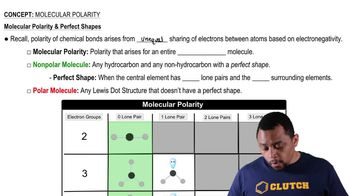
Polarity refers to the distribution of electrical charge around atoms, molecules, or chemical groups. A polar molecule has a significant difference in electronegativity between its atoms, leading to a partial positive charge on one end and a partial negative charge on the other. Nonpolar molecules, in contrast, have an even distribution of charge, resulting in no distinct poles. Understanding polarity is crucial for predicting solubility and interactions between different substances.
추천 영상:
가이드 코스
01:34
Molecular Polarity (Simplified) Concept 1

Solubility

Solubility is the ability of a solute to dissolve in a solvent, forming a homogeneous solution. The principle of 'like dissolves like' explains that polar solutes tend to dissolve well in polar solvents, while nonpolar solutes are more soluble in nonpolar solvents. This concept is essential for understanding the interactions between different substances, particularly in chemical reactions and biological systems.
추천 영상:
가이드 코스
00:28
Solubility Rules

Solvent-Solute Interaction

The interaction between a solvent and a solute is fundamental in determining the solubility and behavior of substances in a solution. In the case of a nonpolar solute and a polar solvent, the lack of attraction between the polar solvent molecules and the nonpolar solute can lead to poor solubility. This concept highlights the importance of molecular interactions in chemistry and helps explain why certain mixtures do not form solutions.
추천 영상: