Ch.9 Solutions
Timberlake - Chemistry: An Introduction to General, Organic, and Biological Chemistry 14th Edition
Timberlake14th EditionChemistry: An Introduction to General, Organic, and Biological ChemistryISBN: 9781292472249당신이 사용하는 게 아니라요?교과서 변경
9장, 문제 80a

Select the container (1, 2, or 3) that represents the dilution of a  solution to give each of the following: (9.5)
a. a 2% (m/v) KCl solution
<IMAGE>

검증된 단계별 안내
1
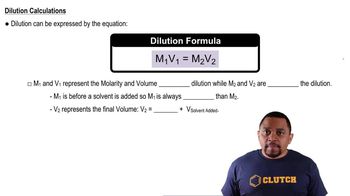
Step 1: Understand the concept of dilution. Dilution involves reducing the concentration of a solution by adding more solvent. The formula for dilution is: C1V1=C2V2, where C1 and V1 are the initial concentration and volume, and C2 and V2 are the final concentration and volume.
Step 2: Identify the target concentration from the problem. In this case, the target concentration is 2% (m/v) KCl. This means 2 grams of KCl per 100 mL of solution.
Step 3: Examine the containers in the image (not provided here) and determine which container has been diluted to achieve the target concentration. Look for visual cues such as the amount of solvent added or the relative concentration of the solution.
Step 4: Use the dilution formula to verify the concentration in each container. For each container, calculate the final concentration using the formula: C2=C1V1V2. Compare the calculated concentration to the target concentration of 2% (m/v).
Step 5: Select the container that matches the target concentration based on your calculations and observations. Ensure that the selected container corresponds to the correct dilution process.

비슷한 문제에 대한 검증된 영상 답변:

이 영상 해법은 위 문제에 도움이 된다고 튜터들이 추천한 것입니다.
영상 길이:
1m
도움이 되었나요?

주요 개념

질문에 올바르게 답하기 위해 반드시 이해해야 하는 핵심 개념들은 다음과 같습니다.

Dilution

Dilution is the process of reducing the concentration of a solute in a solution, typically by adding more solvent. In the context of preparing a specific concentration, it involves calculating the volume of the concentrated solution needed and the volume of solvent to add to achieve the desired final concentration.
추천 영상:

Mass/Volume Percentage (m/v)

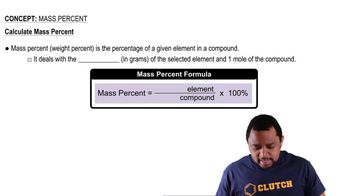
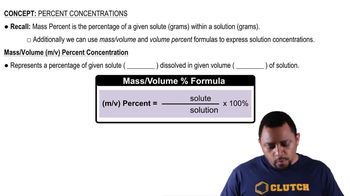
Mass/volume percentage (m/v) is a way to express the concentration of a solution, defined as the mass of solute (in grams) per 100 mL of solution. For example, a 2% (m/v) KCl solution means there are 2 grams of KCl in every 100 mL of the solution, which is crucial for understanding how to prepare the desired concentration.
추천 영상:
가이드 코스
00:38
Mass Percent Concept

Concentration Calculation

Concentration calculation involves using formulas to determine the amount of solute and solvent needed to achieve a specific concentration. This often includes using the dilution equation (C1V1 = C2V2), where C1 and V1 are the concentration and volume of the stock solution, and C2 and V2 are the desired concentration and final volume.
추천 영상:
가이드 코스
00:52
Percent Concentrations Concept 1