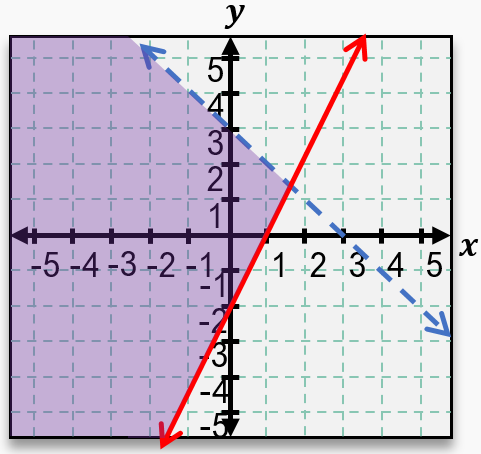
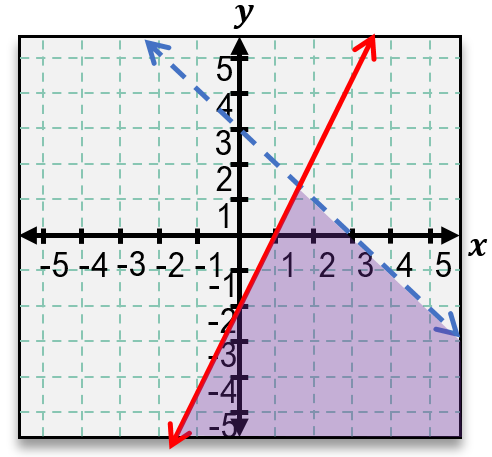
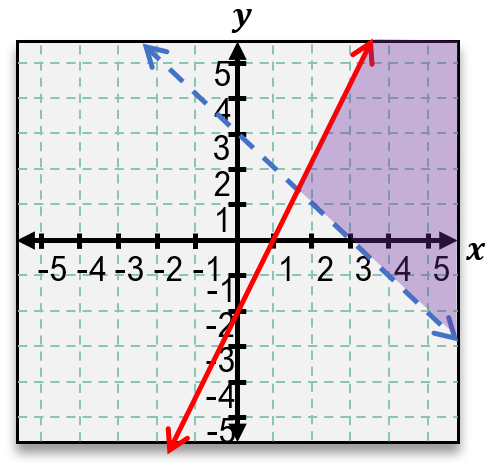
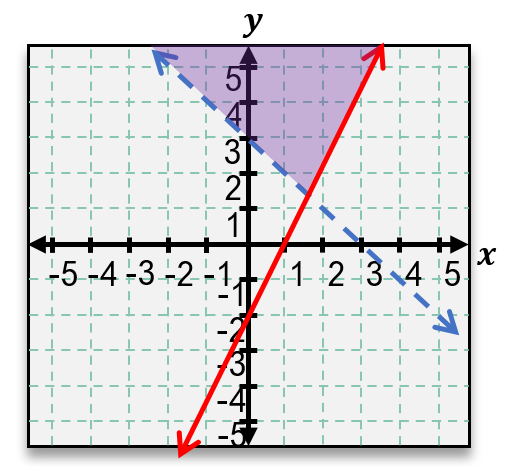
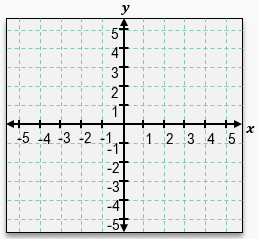
Graph the system of inequalities and indicate the region (if any) of solutions satisfying all equations.
A
B
C
D
0 댓글
검증된 단계별 안내
1
Step 1: Identify the inequalities to graph: \(y \geq 2x - 2\) and \(y > 3 - x\).
Step 2: Graph the boundary lines for each inequality. For \(y \geq 2x - 2\), graph the line \(y = 2x - 2\). For \(y > 3 - x\), graph the line \(y = 3 - x\). Use a solid line for \(y \geq 2x - 2\) because it includes equality, and a dashed line for \(y > 3 - x\) because it does not include equality.
Step 3: Determine the shading for each inequality. For \(y \geq 2x - 2\), shade the region above or on the line. For \(y > 3 - x\), shade the region above the line (not including the line).
Step 4: Find the intersection of the two shaded regions. This overlapping area represents the solution set that satisfies both inequalities simultaneously.
Step 5: Label the solution region clearly on the graph, indicating that it includes points where \(y\) is greater than or equal to \(2x - 2\) and strictly greater than \(3 - x\).




 검증된 단계별 안내

