Skip to main content
Intermediate Algebra
나의 코스
배우기
시험 준비
AI 튜터
학습 가이드
플래시카드
탐험해 보세요
앱을 사용해 보세요
나의 코스
배우기
시험 준비
AI 튜터
학습 가이드
플래시카드
탐험해 보세요
앱을 사용해 보세요
뒤로
Introduction to Inverse Functions quiz
카드를 뒤집기 위해 탭할 수 있습니다.
What is a one-to-one function?
카드를 뒤집기 위해 탭할 수 있습니다.
👆
What is a one-to-one function?
A one-to-one function is a function where each output (y value) is paired with at most one input (x value).
진행 상황 추적
컨트롤 버튼이 '내비게이션' 모드로 변경되었습니다.
1/15
관련 플래시카드
관련 실천
추천 영상
Introduction to Inverse Functions definitions
Introduction to Inverse Functions
15 용어
Introduction to Inverse Functions
11. Inverse, Exponential, & Logarithmic Functions
5 문제점
주제
ZacharyFrye
Exponential Functions
11. Inverse, Exponential, & Logarithmic Functions
5 문제점
주제
AllySteele
11. Inverse, Exponential, & Logarithmic Functions
4 주제
12 문제점
장
ZacharyFrye
VideoThumbView.guidedCourse
03:31
Intro to Inverse Functions
130
views
1
rank
VideoThumbView.guidedCourse
03:30
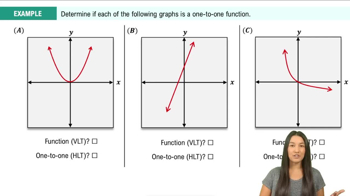
Intro to Inverse Functions Example 2
117
views
2
rank
VideoThumbView.guidedCourse
02:48
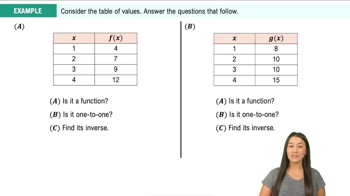
One to One Functions Example 1
149
views
이 집합의 용어 (15)
하이드의 정의
What is a one-to-one function?
A one-to-one function is a function where each output (y value) is paired with at most one input (x value).
How can you quickly check if a function is one-to-one using ordered pairs?
Check if any output value is repeated; if so, the function is not one-to-one.
What test do you use on a graph to determine if a function is one-to-one?
You use the horizontal line test; if any horizontal line passes through more than one point, the function is not one-to-one.
What does the notation f⁻¹ represent?
The notation f⁻¹ represents the inverse function of f, not 1 over f.
How do you form the inverse of a function given as ordered pairs?
Swap each ordered pair's x and y values to create the inverse function.
What happens to the domain and range when forming the inverse of a function?
The domain and range swap; the original domain becomes the inverse's range, and the original range becomes the inverse's domain.
Why can't all functions have inverses?
Only one-to-one functions have inverses because otherwise, the inverse would not be a function.
What is the key feature of a correspondence diagram for a one-to-one function?
Each output has at most one arrow coming in from an input.
How does the horizontal line test relate to the definition of a one-to-one function?
If a horizontal line crosses the graph more than once, it means an output is paired with multiple inputs, so the function is not one-to-one.
What is the difference between the vertical and horizontal line tests?
The vertical line test checks if a graph is a function, while the horizontal line test checks if it is one-to-one.
If a function f has ordered pairs (a, b), what are the ordered pairs for its inverse?
The inverse will have ordered pairs (b, a).
What does it mean if two inputs in a function have the same output?
It means the function is not one-to-one.
How can you use a list of outputs to check if a function is one-to-one?
Look for repeated outputs; if any output is repeated, the function is not one-to-one.
Why is understanding one-to-one functions important for inverse functions?
Because only one-to-one functions have inverses that are also functions.
What does swapping inputs and outputs in a function accomplish?
It creates the inverse function, reversing the roles of domain and range.
 뒤로뒤로
뒤로뒤로

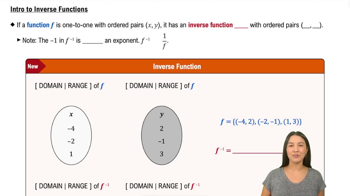
 03:31
03:31