Skip to main content
Intermediate Algebra
나의 코스
배우기
시험 준비
AI 튜터
학습 가이드
플래시카드
탐험해 보세요
앱을 사용해 보세요
나의 코스
배우기
시험 준비
AI 튜터
학습 가이드
플래시카드
탐험해 보세요
앱을 사용해 보세요
뒤로
Introduction to Logarithmic Functions quiz
카드를 뒤집기 위해 탭할 수 있습니다.
What is a logarithm in relation to an exponential function?
카드를 뒤집기 위해 탭할 수 있습니다.
👆
What is a logarithm in relation to an exponential function?
A logarithm is the exponent that a base must be raised to in order to equal a particular number; it is the inverse of an exponential function.
진행 상황 추적
컨트롤 버튼이 '내비게이션' 모드로 변경되었습니다.
1/15
관련 플래시카드
관련 실천
추천 영상
Introduction to Logarithmic Functions definitions
Introduction to Logarithmic Functions
15 용어
Introduction to Logarithmic Functions
11. Inverse, Exponential, & Logarithmic Functions
5 문제점
주제
ErnestBlazevic
Properties of Logarithms
11. Inverse, Exponential, & Logarithmic Functions
5 문제점
주제
ErnestBlazevic
11. Inverse, Exponential, & Logarithmic Functions
4 주제
12 문제점
장
ZacharyFrye
VideoThumbView.guidedCourse
01:22
Basic Properties of Logarithms Example 1
108
views
1
rank
VideoThumbView.guidedCourse
05:50
Basic Properties of Logarithms
110
views
VideoThumbView.guidedCourse
04:20
Converting Between Exponential & Logarithmic Form
117
views
1
rank
이 집합의 용어 (15)
하이드의 정의
What is a logarithm in relation to an exponential function?
A logarithm is the exponent that a base must be raised to in order to equal a particular number; it is the inverse of an exponential function.
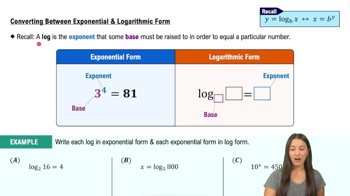
How do you write the exponential equation 2^y = 10 in logarithmic form?
You write it as y = log base 2 of 10, or y = log₂(10).
What does the notation log_b(x) mean?
It means the exponent y such that b^y = x; b is the base and x is the argument.
How are exponential and logarithmic forms related?
They are inverses: y = log_b(x) is equivalent to x = b^y.
What is the base in the logarithmic expression log_5(x)?
The base is 5.
How do you convert the logarithmic equation log_3(81) = 4 to exponential form?
You write it as 3^4 = 81.
What is the inverse function of f(x) = 5^x?
The inverse is f⁻¹(x) = log base 5 of x, or f⁻¹(x) = log₅(x).
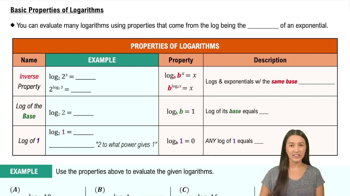
What is the value of log_2(2^3)?
It is 3, because the log and exponential with the same base cancel, leaving the exponent.
What is the value of log_b(b) for any base b?
It is always 1, because b^1 = b.
What is the value of log_b(1) for any base b?
It is always 0, because any base raised to the power of 0 equals 1.
How can you evaluate log_4(16) without a calculator?
Rewrite 16 as 4^2, so log_4(4^2) = 2.
How do you evaluate log_5(1/5) using exponent rules?
Rewrite 1/5 as 5^(-1), so log_5(5^(-1)) = -1.
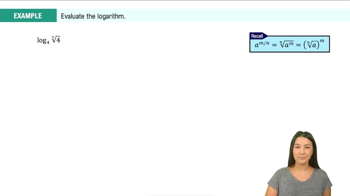
How do you rewrite the cube root of 4 as an exponent?
The cube root of 4 is 4^(1/3).
What is log_4(∛4) equal to?
It is 1/3, because log_4(4^(1/3)) = 1/3.
What two elements should you focus on when converting between exponential and logarithmic forms?
Focus on the base and the exponent, as they determine the structure of both forms.
 뒤로뒤로
뒤로뒤로

 01:22
01:22