Skip to main content
Intermediate Algebra
나의 코스
배우기
시험 준비
AI 튜터
학습 가이드
플래시카드
탐험해 보세요
앱을 사용해 보세요
나의 코스
배우기
시험 준비
AI 튜터
학습 가이드
플래시카드
탐험해 보세요
앱을 사용해 보세요
뒤로
Introduction to Sequences quiz
카드를 뒤집기 위해 탭할 수 있습니다.
What is the domain of a sequence?
카드를 뒤집기 위해 탭할 수 있습니다.
👆
What is the domain of a sequence?
The domain of a sequence is all positive integers, starting from 1 and increasing by 1 each time.
진행 상황 추적
컨트롤 버튼이 '내비게이션' 모드로 변경되었습니다.
1/15
관련 플래시카드
관련 실천
추천 영상
Introduction to Sequences definitions
Introduction to Sequences
15 용어
Introduction to Sequences
13. Sequences, Series, and the Binomial Theorem
5 문제점
주제
ErnestBlazevic
Arithmetic Sequences
13. Sequences, Series, and the Binomial Theorem
5 문제점
주제
ZacharyFrye
13. Sequences, Series, and the Binomial Theorem
4 주제
12 문제점
장
AllySteele
VideoThumbView.guidedCourse
4:19
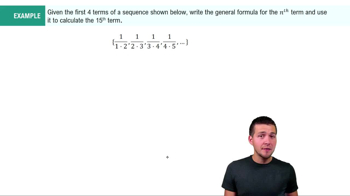
Writing a General Formula Example 6
56
views
VideoThumbView.guidedCourse
5:52
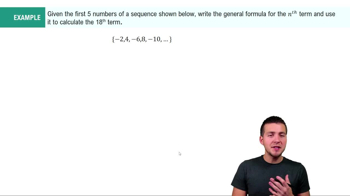
Writing a General Formula Example 5
69
views
VideoThumbView.guidedCourse
01:26
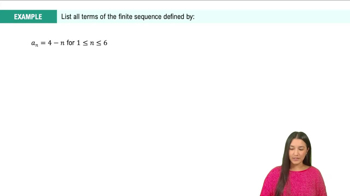
Intro to Sequences Example 2
69
views
이 집합의 용어 (15)
하이드의 정의
What is the domain of a sequence?
The domain of a sequence is all positive integers, starting from 1 and increasing by 1 each time.
How do you find the nth term of a sequence given its general term?
You substitute the index n into the general term formula to calculate the nth term.
What is the difference between a finite and an infinite sequence?
A finite sequence has a limited number of terms, while an infinite sequence continues forever.
How do you represent the first term of a sequence using notation?
The first term is represented as a₁, where n equals 1.
If a sequence is defined by aₙ = 2ⁿ, what is the third term?
The third term is 8, since 2 to the power of 3 equals 8.
How do you find all terms of a finite sequence defined for n = 1 to n = 6?
You substitute n = 1, 2, 3, 4, 5, and 6 into the general term and list each result.
What does it mean if a sequence increases by the same amount each time?
It means the sequence is an arithmetic progression, and its formula includes a term like n, 2n, or 3n.
How do you adjust a sequence formula if the first term is not 1?
You add or subtract a constant to shift the sequence so the first term matches the desired value.
What pattern in a sequence suggests using (-1)ⁿ in the formula?
Alternating signs in the sequence indicate you should use (-1) raised to the n power.
How do you write a formula for a sequence with alternating signs and a constant value?
Multiply (-1)ⁿ by the constant value to alternate the sign for each term.
What does it mean if a sequence contains fractions with numerators and denominators increasing by 1?
It means the formula will have n in the numerator and n plus a constant in the denominator.
How do you determine the numerator and denominator in a sequence like 1/2, 2/3, 3/4?
The numerator is n, and the denominator is n + 1.
What type of sequence is represented by 2, 4, 8, 16, 32?
This is a geometric or exponential sequence, where each term is a constant raised to the n power.
How do you recognize an exponential pattern in a sequence?
If the difference between terms is not constant but the ratio is, the sequence is exponential.
What is an explicit formula for a sequence?
An explicit formula is an equation involving n that allows you to find any term in the sequence directly.
 뒤로뒤로
뒤로뒤로


 4:19
4:19