Skip to main content
Intermediate Algebra
나의 코스
배우기
시험 준비
AI 튜터
학습 가이드
플래시카드
탐험해 보세요
앱을 사용해 보세요
나의 코스
배우기
시험 준비
AI 튜터
학습 가이드
플래시카드
탐험해 보세요
앱을 사용해 보세요
뒤로
The Square Root Property quiz
카드를 뒤집기 위해 탭할 수 있습니다.
What is the square root property used for when solving quadratic equations?
카드를 뒤집기 위해 탭할 수 있습니다.
👆
What is the square root property used for when solving quadratic equations?
It is used to solve equations where a squared term is isolated, allowing us to take the square root of both sides to find the solution.
진행 상황 추적
컨트롤 버튼이 '내비게이션' 모드로 변경되었습니다.
1/15
관련 플래시카드
관련 실천
추천 영상
The Square Root Property definitions
The Square Root Property
15 용어
The Square Root Property
10. Quadratic Equations and Functions
5 문제점
주제
ErnestBlazevic
Completing the Square
10. Quadratic Equations and Functions
5 문제점
주제
ErnestBlazevic
10. Quadratic Equations and Functions
4 주제
12 문제점
장
ErnestBlazevic
VideoThumbView.guidedCourse
05:34
Using The Square Root Property
201
views
4
rank
VideoThumbView.guidedCourse
02:26
Imaginary Solutions
134
views
1
rank
VideoThumbView.guidedCourse
02:09
Using The Square Root Property Example 1
124
views
3
rank
이 집합의 용어 (15)
하이드의 정의
What is the square root property used for when solving quadratic equations?
It is used to solve equations where a squared term is isolated, allowing us to take the square root of both sides to find the solution.
What is the general form of a quadratic equation suitable for the square root property?
The form is x^2 = k, where k is a constant.
What are the solutions to x^2 = k according to the square root property?
The solutions are x = ±√k, meaning both the positive and negative square roots.
Why do we include both positive and negative square roots when solving x^2 = k?
Because both (positive)^2 and (negative)^2 yield the same positive value k.
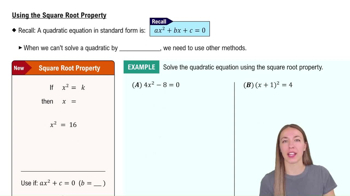
How do you solve 4x^2 - 8 = 0 using the square root property?
Isolate x^2 to get x^2 = 2, then x = ±√2.
What is the solution to x^2 = 16?
x = ±4, since √16 = 4.
How do you solve (x + 1)^2 = 4 using the square root property?
Take the square root of both sides to get x + 1 = ±2, then solve for x to get x = 1 or x = -3.
When can you use the square root property to solve a quadratic equation?
When a squared term is isolated and equal to a constant, especially if the linear term is missing.
What happens if the constant under the square root is negative?
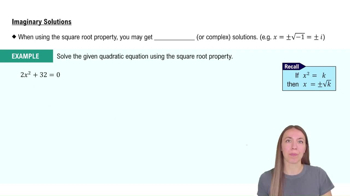
The solutions become imaginary, involving the imaginary unit i.
How do you simplify √(-16)?
Rewrite as √16 × √(-1), which is 4i.
What are the solutions to x^2 = -9?
x = ±3i, since √(-9) = 3i.
How do you solve 2x^2 + 32 = 0 using the square root property?
Isolate x^2 to get x^2 = -16, then x = ±4i.
What is the imaginary unit and how is it used in square root property problems?
The imaginary unit is i, defined as √(-1), and is used when the square root property yields negative values under the root.
Why is it important to check your solutions by plugging them back into the original equation?
To verify that the solutions satisfy the original equation and are correct.
What type of quadratic equations are most easily solved using the square root property?
Equations missing the linear term (b coefficient is zero) or those with a binomial squared.
 뒤로
뒤로
 05:34
05:34