 뒤로
뒤로Intermediate Algebra: Fractions and Real Numbers
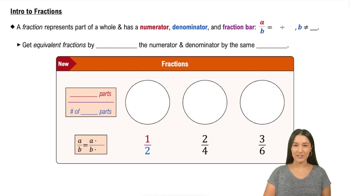
 05:07
05:07
이 집합의 용어 (15)
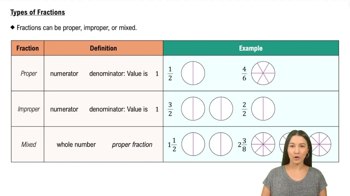
Multiply the denominator by the whole number, add the numerator, then place the result over the original denominator.
\(\frac{11}{4}\)
Divide the numerator by the denominator; the quotient is the whole number, and the remainder is the new numerator over the original denominator.
\(1\frac{3}{5}\)
Change mixed numbers to improper fractions before multiplying or dividing.
Line up the mixed numbers vertically to align like terms.
Natural numbers, whole numbers, integers, rational numbers, and irrational numbers.
Counting numbers starting from 1, 2, 3, and so on.
Natural numbers including zero: 0, 1, 2, 3, ...
Whole numbers and their negatives: ..., -3, -2, -1, 0, 1, 2, 3, ...
Numbers that can be expressed as a fraction of two integers, including integers, fractions, and terminating or repeating decimals.
Numbers that cannot be expressed as a fraction, with non-terminating, non-repeating decimals, like \(\pi\) and \(\sqrt{2}\).
{ m, a, t, h, e, i, c, s }
{ 1, 3, 5, 7, 9 }
A way to describe a set by stating the properties that its members must satisfy.