Skip to main content
Intermediate Algebra
나의 코스
배우기
시험 준비
AI 튜터
학습 가이드
플래시카드
탐험해 보세요
앱을 사용해 보세요
나의 코스
배우기
시험 준비
AI 튜터
학습 가이드
플래시카드
탐험해 보세요
앱을 사용해 보세요
뒤로
Intermediate Algebra: Fractions, Real Numbers, and Inequalities
카드를 뒤집기 위해 탭할 수 있습니다.
How do you simplify a fraction?
카드를 뒤집기 위해 탭할 수 있습니다.
👆
How do you simplify a fraction?
Cancel out common factors in the numerator and denominator.
진행 상황 추적
컨트롤 버튼이 '내비게이션' 모드로 변경되었습니다.
1/20
추천 영상
VideoThumbView.guidedCourse
05:07
Intro to Fractions
1523
views
67
rank
VideoThumbView.guidedCourse
03:42
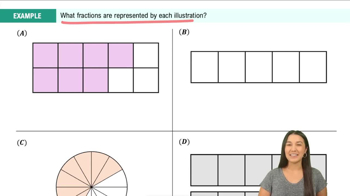
Intro to Fractions Example 1
460
views
20
rank
VideoThumbView.guidedCourse
05:25
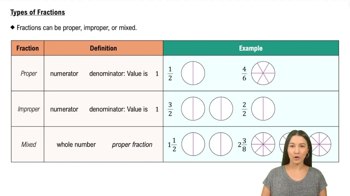
Types of Fractions
618
views
39
rank
이 집합의 용어 (20)
하이드의 정의
How do you simplify a fraction?
Cancel out common factors in the numerator and denominator.
What is the rule for multiplying fractions?
Multiply across numerators and denominators, then reduce if possible.
How do you divide fractions?
Flip the second fraction (take the reciprocal) and multiply.
How do you add or subtract fractions with different denominators?
Find the least common denominator (LCD), convert fractions, then add or subtract numerators only.
What is the least common denominator (LCD) of 12 and 8?
The LCD is 24.
How do you convert a mixed number to an improper fraction?
Multiply the whole number by the denominator and add the numerator; place the result over the original denominator.
How do you convert an improper fraction to a mixed number?
Divide the numerator by the denominator; the quotient is the whole number and the remainder is the numerator of the fraction.
What are natural numbers?
Counting numbers starting from 1, 2, 3, 4, 5, ...
What are whole numbers?
Natural numbers including zero: 0, 1, 2, 3, 4, 5, ...
What are integers?
Whole numbers and their negatives: ..., -3, -2, -1, 0, 1, 2, 3, ...
What are rational numbers?
Numbers that can be expressed as a quotient of two integers (fractions or decimals that terminate or repeat).
What are irrational numbers?
Numbers that cannot be expressed as a fraction and have non-terminating, non-repeating decimals, such as pi.
What are real numbers?
All rational and irrational numbers combined.
How is absolute value defined?
The distance of a number from zero on the number line; always non-negative.
What does the inequality symbol '<' mean?
Means 'less than'; the value on the left is smaller than the value on the right.
What does the inequality symbol '>' mean?
Means 'greater than'; the value on the left is larger than the value on the right.
What does the inequality symbol '≤' mean?
Means 'less than or equal to'; the value on the left is smaller than or equal to the value on the right.
What does the inequality symbol '≥' mean?
Means 'greater than or equal to'; the value on the left is larger than or equal to the value on the right.
How do you compare absolute values of numbers?
Compare their distances from zero regardless of sign.
How do you add fractions with unlike denominators?
Find the LCD, convert each fraction, then add the numerators.
 뒤로뒤로
뒤로뒤로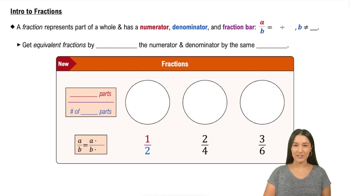
 05:07
05:07