A similar arrangement of internal organs is observed in birds, rodents, and frogs. This is likely an example of:
목차
- 1. Introduction to Biology2h 40m
- 2. Essential Chemistry for Biology2h 43m
- 3. The Molecules of Life2h 18m
- 4. A Tour of the Cell2h 7m
- 5. The Working Cell1h 29m
- 6. Cellular Respiration: Obtaining Energy from Food1h 8m
- 7. Photosynthesis: Using Light to Make Food1h 44m
- 8. Cellular Reproduction: Cells from Cells2h 55m
- 9. Patterns of Inheritance2h 53m
- 10. The Structure and Function of DNA4h 19m
- 11. How Genes Are Controlled55m
- 12. DNA Technology33m
- 13. How Populations Evolve6h 12m
- 14. How Biological Diversity Evolves3h 29m
- 15. The Evolution of Microbial Life2h 8m
- 16. The Evolution of Plants and Fungi1h 58m
- 17. The Evolution of Animals3h 25m
- 18. An Introduction to Ecology and the Biosphere2h 3m
- 19. Population Ecology2h 9m
- 20. Communities and Ecosystems4h 29m
- 21. Unifying Concepts of Animal Structure and Function2h 17m
- 22. Nutrition and Digestion1h 2m
- 23. Circulation and Respiration1h 46m
- 24. The Body's Defenses1h 14m
- 25. Hormones1h 4m
- 26. Reproduction and Development1h 2m
- 27. Nervous, Sensory, and Locomotor Systems2h 57m
- 28. The Life of a Flowering Plant1h 50m
- 29. The Working Plant2h 33m
13. How Populations Evolve
Evidence of Evolution
객관식
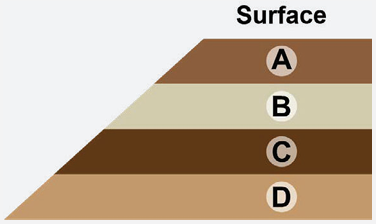
Sedimentary rock creates distinct layers that paleontologists can use to help interpret their findings. Use the image below to determine which of the following statements is true about fossils and sedimentary rock.

A
The fossils found in layer B will be older than the fossils in layer A.
B
More fossils are likely found in layer C than in layer B.
C
Fossils are most likely to be found in the transitions between layers.
D
Fossils in layer C are likely to be the ancestors of fossils in layer D.
0 댓글
관련 영상
관련 실천
객관식
8
views