Electrostatic potential maps of acetic acid (CH₃CO₂H) and ethyl alcohol (CH₃CH₂OH) are shown. Identify the most acidic hydrogen in each, and tell which of the two is likely to be the stronger acid.
검증된 단계별 안내
1
Identify the acidic hydrogen in acetic acid (CH₃CO₂H) by looking for the hydrogen atom attached to the oxygen in the carboxyl group (COOH).
Identify the acidic hydrogen in trifluoroacetic acid (CF₃CO₂H) by looking for the hydrogen atom attached to the oxygen in the carboxyl group (COOH).
Compare the electrostatic potential maps: red areas indicate regions of high electron density, while blue areas indicate regions of low electron density.
Note that the presence of electronegative atoms like fluorine in CF₃COOH increases the acidity by stabilizing the negative charge on the conjugate base.
Conclude that CF₃COOH is likely the stronger acid due to the electron-withdrawing effect of the fluorine atoms, which stabilizes the conjugate base more effectively than in CH₃COOH.
비슷한 문제에 대한 검증된 영상 답변:
이 영상 해법은 위 문제에 도움이 된다고 튜터들이 추천한 것입니다.
영상 길이:
5m
영상 재생:
0 댓글
주요 개념
질문에 올바르게 답하기 위해 반드시 이해해야 하는 핵심 개념들은 다음과 같습니다.
Acidity and Acidic Protons
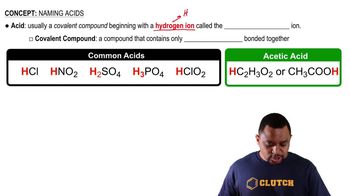
Acidity refers to the ability of a substance to donate protons (H⁺ ions) in a chemical reaction. The acidic protons in a molecule are typically those attached to electronegative atoms, such as oxygen in carboxylic acids. In acetic acid (CH₃COOH), the hydrogen in the carboxyl group (-COOH) is the most acidic, while in ethyl alcohol (CH₃CH₂OH), the hydroxyl group (-OH) contains the acidic hydrogen.
Electrostatic potential maps visually represent the distribution of electron density in a molecule, indicating regions of positive and negative charge. Areas of high electron density are shown in red and yellow, while low density appears in blue and green. These maps help identify the most acidic hydrogen by highlighting the regions where protons are more likely to dissociate, thus indicating acidity.
Comparative acidity involves evaluating the strength of acids based on their ability to donate protons. Factors influencing acidity include the stability of the conjugate base formed after deprotonation and the electronegativity of atoms attached to the acidic hydrogen. In this case, acetic acid is generally a stronger acid than ethyl alcohol due to the resonance stabilization of its conjugate base, acetate, compared to the ethoxide ion formed from ethyl alcohol.

 5:28분
5:28분
 검증된 단계별 안내
 02:15
02:15