Which of the following ions are likely to form? Explain.
a. Li^2+
b. K-
c. Mn^3+
d. Zn^4+
e. Ne+
검증된 단계별 안내
1
Step 1: Understand the concept of ion formation. Ions are formed when atoms gain or lose electrons to achieve a stable electron configuration, often resembling the nearest noble gas.
Step 2: Analyze each ion option. Consider the electron configuration of the neutral atom and how gaining or losing electrons affects stability.
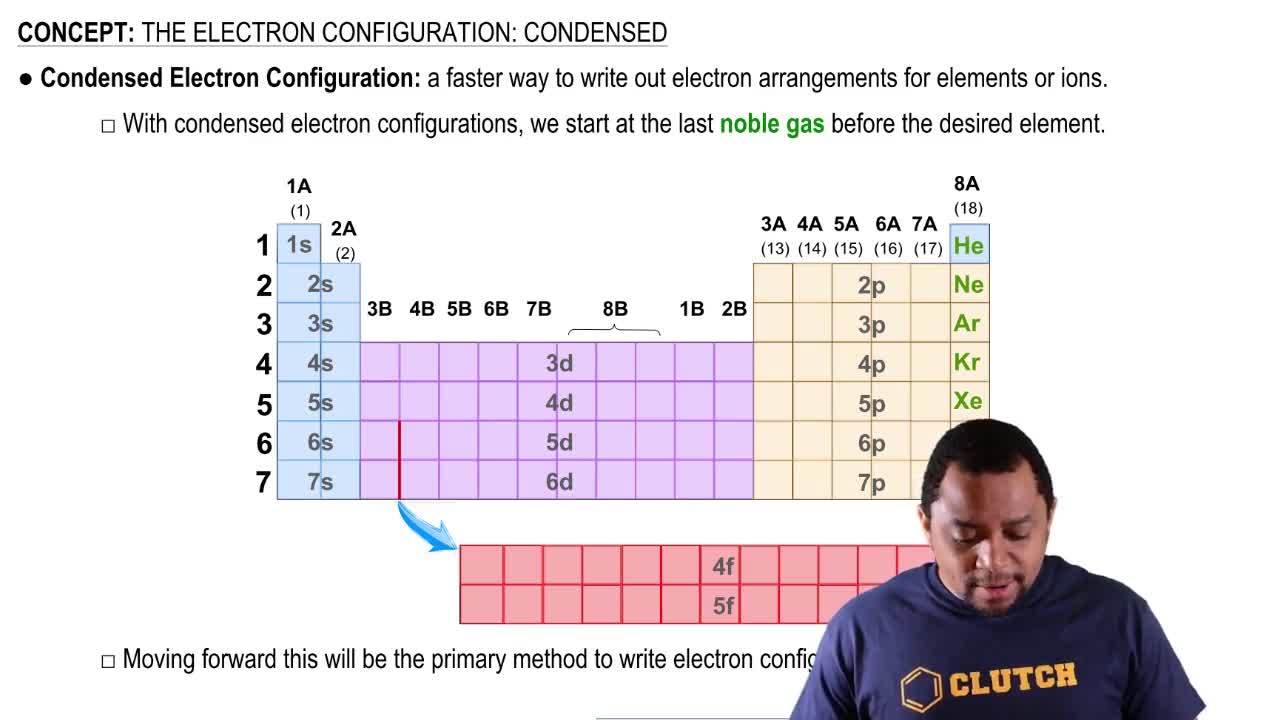
Step 3: Evaluate Li^2+. Lithium (Li) has an electron configuration of 1s^2 2s^1. Losing one electron forms Li^+, achieving a stable configuration like helium. Losing two electrons to form Li^2+ would result in an unstable configuration.
Step 4: Evaluate K-. Potassium (K) has an electron configuration of [Ar] 4s^1. Gaining an electron to form K- would result in an unstable configuration, as it would not resemble a noble gas.
Step 5: Evaluate Mn^3+, Zn^4+, and Ne+. Consider the electron configurations and stability of these ions. Mn^3+ is common due to its stable half-filled d-orbital configuration. Zn^4+ and Ne+ are unlikely due to instability and noble gas configuration, respectively.
비슷한 문제에 대한 검증된 영상 답변:
이 영상 해법은 위 문제에 도움이 된다고 튜터들이 추천한 것입니다.
영상 길이:
3m
영상 재생:
0 댓글
주요 개념
질문에 올바르게 답하기 위해 반드시 이해해야 하는 핵심 개념들은 다음과 같습니다.
Ionic Charge and Stability
Ionic charge refers to the electrical charge an atom or molecule carries due to the loss or gain of electrons. Atoms tend to form ions to achieve a stable electron configuration, often resembling the nearest noble gas. For example, metals typically lose electrons to form positive ions, while nonmetals gain electrons to form negative ions.
Certain ions are more likely to form based on their position in the periodic table and their electron configurations. For instance, alkali metals like potassium (K) usually form +1 ions, while transition metals can have multiple oxidation states. Understanding these trends helps predict which ions are stable and likely to exist.
Electron configuration describes the distribution of electrons in an atom's orbitals. Valence electrons, the outermost electrons, play a crucial role in chemical bonding and ion formation. Analyzing the electron configuration of an element helps determine its tendency to gain or lose electrons, influencing its ability to form stable ions.

 3:30분
3:30분 검증된 단계별 안내
 02:33
02:33