Balance the following equation, and tell how many moles of nickel will react with 9.81 mol of hydrochloric acid.
Ni(s) + HCl(aq) → NiCl2(aq) + H2(g)
검증된 단계별 안내
1
Identify the unbalanced chemical equation: \( \text{Ni(s)} + \text{HCl(aq)} \rightarrow \text{NiCl}_2\text{(aq)} + \text{H}_2\text{(g)} \).
Balance the equation by ensuring the number of atoms of each element is the same on both sides. Start by balancing the chlorine atoms: \( \text{Ni(s)} + 2\text{HCl(aq)} \rightarrow \text{NiCl}_2\text{(aq)} + \text{H}_2\text{(g)} \).
Verify that the equation is balanced by checking each element: Nickel (1 Ni), Chlorine (2 Cl), and Hydrogen (2 H) are balanced.
Use the balanced equation to determine the stoichiometric relationship between nickel and hydrochloric acid: 1 mole of Ni reacts with 2 moles of HCl.
Calculate the moles of nickel needed for 9.81 moles of HCl using the stoichiometric ratio: \( \frac{1 \text{ mol Ni}}{2 \text{ mol HCl}} \times 9.81 \text{ mol HCl} \).
비슷한 문제에 대한 검증된 영상 답변:
이 영상 해법은 위 문제에 도움이 된다고 튜터들이 추천한 것입니다.
영상 길이:
2m
영상 재생:
0 댓글
주요 개념
질문에 올바르게 답하기 위해 반드시 이해해야 하는 핵심 개념들은 다음과 같습니다.
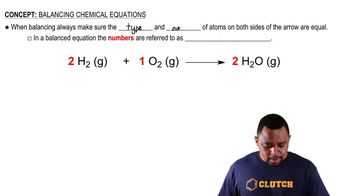
Balancing Chemical Equations
Balancing chemical equations involves ensuring that the number of atoms of each element is the same on both sides of the equation. This is achieved by adjusting the coefficients in front of the chemical formulas. For the given reaction, balancing is crucial to determine the stoichiometric relationships between reactants and products.
Balancing Chemical Equations (Simplified) Concept 1
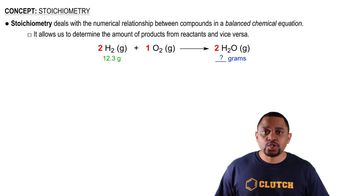
Stoichiometry
Stoichiometry is the calculation of reactants and products in chemical reactions based on the balanced equation. It allows us to determine how many moles of one substance will react with a given amount of another. In this case, stoichiometry will help us find the moles of nickel that react with 9.81 moles of hydrochloric acid.
The mole concept is a fundamental principle in chemistry that relates the mass of a substance to the number of particles it contains. One mole of any substance contains Avogadro's number of entities (approximately 6.022 x 10^23). Understanding this concept is essential for converting between moles and grams, and for calculating the amounts of reactants and products in a chemical reaction.