Identify the most commonly used units for measuring pressure in chemistry and physics.
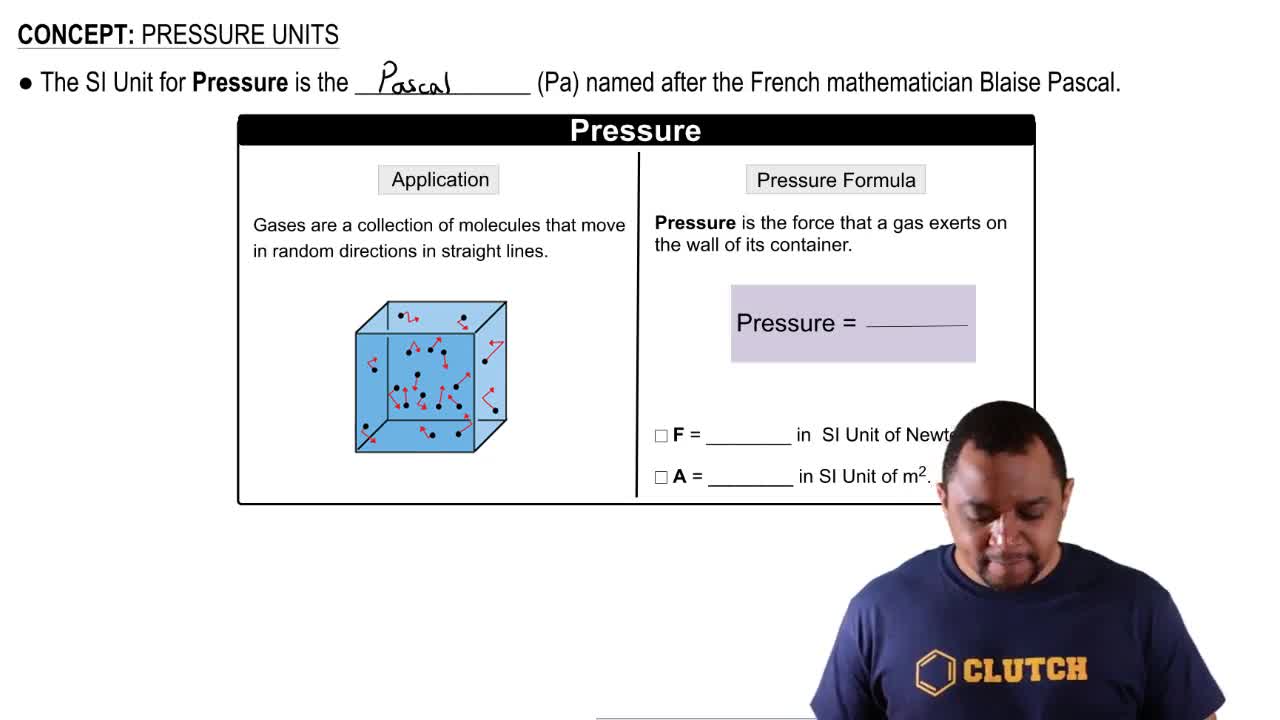
Consider the unit Pascal (Pa), which is the SI unit for pressure, defined as one newton per square meter.
Include the atmosphere (atm), a unit based on the average atmospheric pressure at sea level.
Mention the millimeter of mercury (mmHg), also known as torr, which is often used in measuring blood pressure and vacuum systems.
Add the bar, which is a metric unit of pressure, slightly less than the atmosphere, commonly used in meteorology and engineering.
비슷한 문제에 대한 검증된 영상 답변:
이 영상 해법은 위 문제에 도움이 된다고 튜터들이 추천한 것입니다.
영상 길이:
33s
영상 재생:
0 댓글
주요 개념
질문에 올바르게 답하기 위해 반드시 이해해야 하는 핵심 개념들은 다음과 같습니다.
Pressure
Pressure is defined as the force exerted per unit area on a surface. It is a fundamental concept in physics and chemistry, influencing various phenomena such as gas behavior and fluid dynamics. Understanding pressure is essential for interpreting how gases expand, contract, and interact with their surroundings.
Units of measurement provide a standard way to quantify physical quantities. In the context of pressure, different units can be used depending on the application, such as atmospheres (atm), pascals (Pa), millimeters of mercury (mmHg), and pounds per square inch (psi). Familiarity with these units is crucial for accurate communication and calculations in scientific contexts.
Converting between different units of pressure is often necessary in scientific work to ensure consistency and accuracy. Each unit has a specific relationship with others, such as 1 atm being equivalent to 101.325 kPa or 760 mmHg. Understanding these conversions allows for effective comparison and analysis of pressure measurements across various contexts.

 0:33분
0:33분 검증된 단계별 안내
 01:15
01:15