Determine the density (g/mL) for each of the following:
a. A 20.0-mL sample of a salt solution has a mass of 24.0 g.
검증된 단계별 안내
1
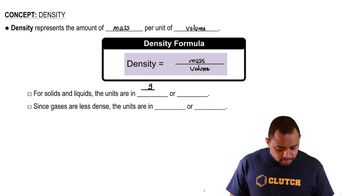
Identify the formula for density: \( \text{Density} = \frac{\text{Mass}}{\text{Volume}} \).
Determine the mass of the salt solution, which is given as 24.0 g.
Determine the volume of the salt solution, which is given as 20.0 mL.
Substitute the mass and volume values into the density formula: \( \text{Density} = \frac{24.0 \text{ g}}{20.0 \text{ mL}} \).
Simplify the expression to find the density in g/mL.
비슷한 문제에 대한 검증된 영상 답변:
이 영상 해법은 위 문제에 도움이 된다고 튜터들이 추천한 것입니다.
영상 길이:
35s
영상 재생:
0 댓글
주요 개념
질문에 올바르게 답하기 위해 반드시 이해해야 하는 핵심 개념들은 다음과 같습니다.
Density
Density is defined as the mass of a substance divided by its volume, typically expressed in grams per milliliter (g/mL) for liquids. It is a crucial physical property that helps identify substances and understand their behavior in different contexts. The formula for calculating density is: Density = Mass/Volume.
Mass is the amount of matter in an object, measured in grams (g), while volume is the space that a substance occupies, measured in milliliters (mL) for liquids. Accurate measurement of both mass and volume is essential for calculating density. In this question, the mass of the salt solution is given as 24.0 g, and the volume is 20.0 mL.
To calculate the density of a solution, you divide the mass of the solution by its volume. In this case, you would take the mass of 24.0 g and divide it by the volume of 20.0 mL. This calculation will yield the density of the salt solution, which is important for understanding its concentration and properties.

 0:35분
0:35분 검증된 단계별 안내
 01:56
01:56