목차
- 1. The Chemical World9m
- 2. Measurement and Problem Solving2h 19m
- 3. Matter and Energy2h 23m
- Classification of Matter18m
- States of Matter8m
- Physical & Chemical Changes19m
- Chemical Properties8m
- Physical Properties5m
- Temperature (Simplified)9m
- Law of Conservation of Mass5m
- Nature of Energy5m
- First Law of Thermodynamics7m
- Endothermic & Exothermic Reactions7m
- Heat Capacity23m
- Thermal Equilibrium (Simplified)9m
- Intensive vs. Extensive Properties13m
- 4. Atoms and Elements2h 33m
- The Atom (Simplified)9m
- Subatomic Particles (Simplified)11m
- Isotopes17m
- Ions (Simplified)22m
- Atomic Mass (Simplified)17m
- Periodic Table: Element Symbols6m
- Periodic Table: Classifications11m
- Periodic Table: Group Names8m
- Periodic Table: Representative Elements & Transition Metals7m
- Periodic Table: Phases (Simplified)9m
- Periodic Table: Main Group Element Charges12m
- Atomic Theory9m
- Rutherford Gold Foil Experiment9m
- 5. Molecules and Compounds1h 51m
- Law of Definite Proportions9m
- Periodic Table: Elemental Forms (Simplified)6m
- Naming Monoatomic Cations7m
- Naming Monoatomic Anions5m
- Polyatomic Ions25m
- Naming Ionic Compounds11m
- Writing Formula Units of Ionic Compounds7m
- Naming Acids18m
- Naming Binary Molecular Compounds6m
- Molecular Models4m
- Calculating Molar Mass9m
- 6. Chemical Composition1h 23m
- 7. Chemical Reactions1h 43m
- 8. Quantities in Chemical Reactions1h 8m
- 9. Electrons in Atoms and the Periodic Table2h 32m
- Wavelength and Frequency (Simplified)6m
- Electromagnetic Spectrum (Simplified)11m
- Bohr Model (Simplified)9m
- Emission Spectrum (Simplified)3m
- Electronic Structure4m
- Electronic Structure: Shells5m
- Electronic Structure: Subshells4m
- Electronic Structure: Orbitals11m
- Electronic Structure: Electron Spin3m
- Electronic Structure: Number of Electrons4m
- The Electron Configuration (Simplified)20m
- The Electron Configuration: Condensed4m
- Ions and the Octet Rule9m
- Valence Electrons of Elements (Simplified)5m
- Periodic Trend: Metallic Character4m
- Periodic Trend: Atomic Radius (Simplified)7m
- Periodic Trend: Ionization Energy (Simplified)9m
- Periodic Trend: Electron Affinity (Simplified)7m
- Electron Arrangements5m
- The Electron Configuration: Exceptions (Simplified)12m
- 10. Chemical Bonding2h 10m
- Lewis Dot Symbols (Simplified)7m
- Ionic Bonding6m
- Covalent Bonds6m
- Lewis Dot Structures: Neutral Compounds (Simplified)8m
- Bonding Preferences6m
- Multiple Bonds4m
- Lewis Dot Structures: Multiple Bonds10m
- Lewis Dot Structures: Ions (Simplified)8m
- Lewis Dot Structures: Exceptions (Simplified)12m
- Resonance Structures (Simplified)5m
- Valence Shell Electron Pair Repulsion Theory (Simplified)4m
- Electron Geometry (Simplified)7m
- Molecular Geometry (Simplified)9m
- Bond Angles (Simplified)11m
- Dipole Moment (Simplified)14m
- Molecular Polarity (Simplified)7m
- 11 Gases2h 17m
- 12. Liquids, Solids, and Intermolecular Forces1h 11m
- 13. Solutions3h 1m
- 14. Acids and Bases2h 14m
- 15. Chemical Equilibrium1h 27m
- 16. Oxidation and Reduction1h 33m
- 17. Radioactivity and Nuclear Chemistry53m
8. Quantities in Chemical Reactions
Thermochemical Equations
문제 74
교과서 질문
Methanol, CH3OH, is used as race car fuel. How many kilojoules are released by burning 50.0 g of methanol?
검증된 단계별 안내1
Identify the chemical reaction for the combustion of methanol: \( 2 \text{CH}_3\text{OH} + 3 \text{O}_2 \rightarrow 2 \text{CO}_2 + 4 \text{H}_2\text{O} \).
Determine the molar mass of methanol (CH₃OH) by adding the atomic masses of its constituent atoms: C (12.01 g/mol), H (1.01 g/mol), and O (16.00 g/mol).
Calculate the number of moles of methanol in 50.0 g by dividing the mass by the molar mass of methanol.
Use the standard enthalpy change of combustion for methanol, which is typically given in kilojoules per mole, to find the energy released per mole of methanol burned.
Multiply the number of moles of methanol by the enthalpy change of combustion to find the total energy released in kilojoules.
비슷한 문제에 대한 검증된 영상 답변:이 영상 해법은 위 문제에 도움이 된다고 튜터들이 추천한 것입니다.
영상 길이:
4m영상 재생:
0 댓글
주요 개념
질문에 올바르게 답하기 위해 반드시 이해해야 하는 핵심 개념들은 다음과 같습니다.
Combustion Reaction
A combustion reaction is a chemical process in which a substance reacts rapidly with oxygen, producing heat and light. In the case of methanol (CH3OH), its combustion yields carbon dioxide (CO2) and water (H2O), releasing energy. Understanding this reaction is crucial for calculating the energy released during the burning of methanol.
추천 영상:
가이드 코스
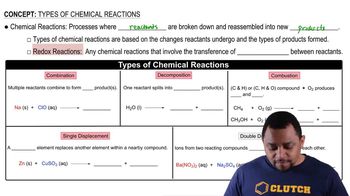
Types of Chemical Reactions Concept 1
Molar Mass
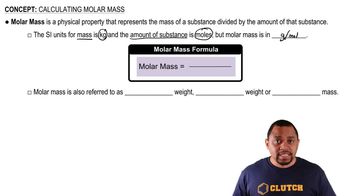
Molar mass is the mass of one mole of a substance, expressed in grams per mole (g/mol). For methanol, the molar mass is approximately 32.04 g/mol. This concept is essential for converting the mass of methanol (50.0 g) into moles, which is necessary for determining the energy released during its combustion.
추천 영상:
가이드 코스
Calculating Molar Mass
Enthalpy of Combustion
The enthalpy of combustion is the amount of energy released when one mole of a substance is completely burned in oxygen. For methanol, this value is typically around -726 kJ/mol. Knowing this value allows us to calculate the total energy released from burning a specific mass of methanol by using the number of moles derived from its mass.
추천 영상:
가이드 코스
Types of Chemical Reactions Concept 1
관련 영상
관련 실천
교과서 질문
Converting liquid water to solid ice releases 1.44 kcal/mol (6.02 kJ/mol).
How many kilocalories are released by freezing 32 g of H2O?
1965
views