Write the equality and two conversion factors, and identify the numbers as exact or give the number of significant figures for each of the following:
a. The label on a bottle reads 10 mg of furosemide per 1 mL.
검증된 단계별 안내
1
Identify the given information: 10 mg of furosemide per 1 mL.
Write the equality based on the given information: 10 mg = 1 mL.
Create the first conversion factor from the equality: \( \frac{10 \, \text{mg}}{1 \, \text{mL}} \).
Create the second conversion factor by inverting the first: \( \frac{1 \, \text{mL}}{10 \, \text{mg}} \).
Determine the number of significant figures: '10 mg' has 1 significant figure, and '1 mL' is an exact number.
비슷한 문제에 대한 검증된 영상 답변:
이 영상 해법은 위 문제에 도움이 된다고 튜터들이 추천한 것입니다.
영상 길이:
2m
영상 재생:
0 댓글
주요 개념
질문에 올바르게 답하기 위해 반드시 이해해야 하는 핵심 개념들은 다음과 같습니다.
Significant Figures
Significant figures are the digits in a number that contribute to its precision. This includes all non-zero digits, any zeros between significant digits, and trailing zeros in the decimal portion. Understanding significant figures is crucial for accurately reporting measurements and performing calculations in chemistry, as it reflects the precision of the data.
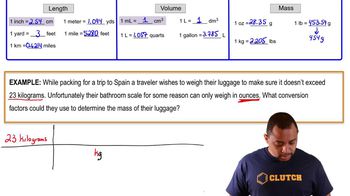
Conversion factors are ratios that express how many of one unit are equal to another unit. They are essential in chemistry for converting measurements from one unit to another, such as milligrams to grams or milliliters to liters. In this context, the conversion factors can be derived from the equality given in the problem, allowing for accurate unit conversions.
Exact numbers are values that are counted or defined and have no uncertainty, such as the number of items in a dozen or defined conversion factors like 1 mL = 1 cm³. In contrast, measured numbers have a degree of uncertainty and are subject to significant figures. Identifying whether a number is exact or measured is important for determining how to report results and perform calculations.

 2:43분
2:43분 검증된 단계별 안내
 01:09
01:09