Use arrows to show electron pairing in the valence p subshell of
a. Sulfur
b. Bromine
c. Silicon
검증된 단계별 안내
1
insert step 1: Identify the electron configuration for each element.
insert step 2: Determine the number of electrons in the valence p subshell for each element.
insert step 3: Use arrows to represent the electrons in the p subshell, following Hund's rule and the Pauli exclusion principle.
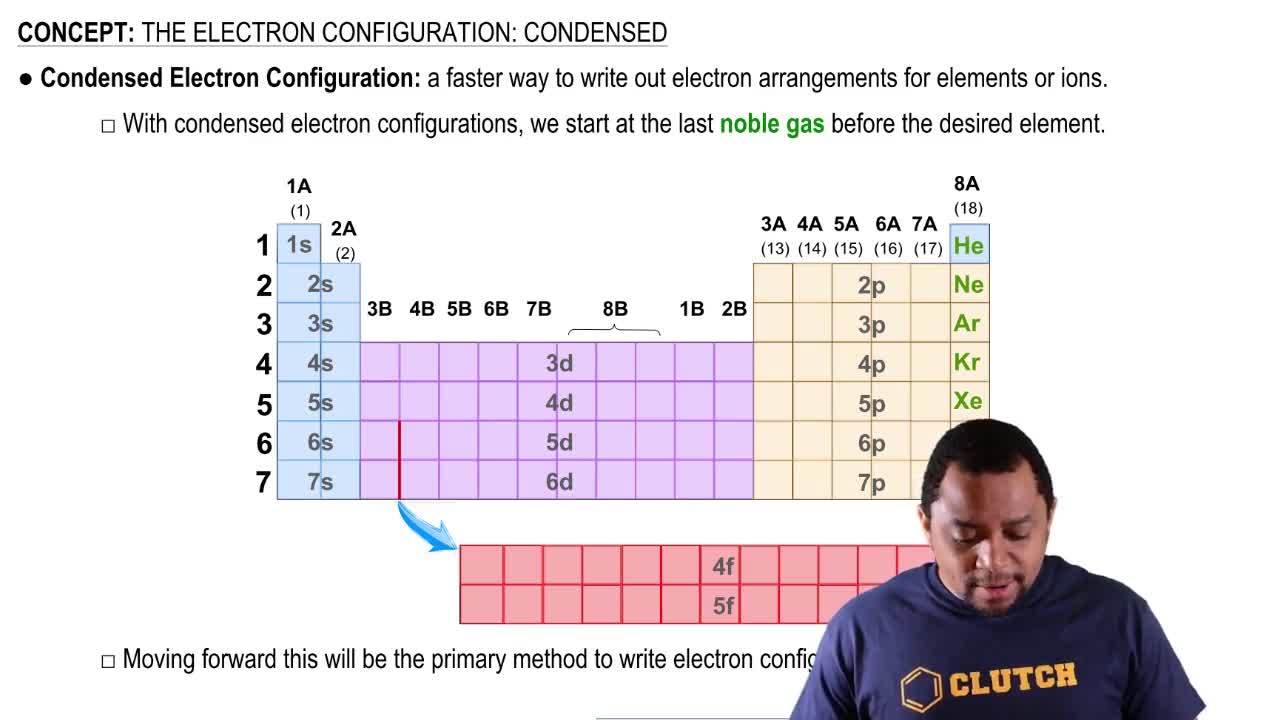
insert step 4: For sulfur (S), with an atomic number of 16, the electron configuration is [Ne] 3s^2 3p^4. The valence p subshell has 4 electrons.
insert step 5: For bromine (Br), with an atomic number of 35, the electron configuration is [Ar] 4s^2 3d^10 4p^5. The valence p subshell has 5 electrons. For silicon (Si), with an atomic number of 14, the electron configuration is [Ne] 3s^2 3p^2. The valence p subshell has 2 electrons.
비슷한 문제에 대한 검증된 영상 답변:
이 영상 해법은 위 문제에 도움이 된다고 튜터들이 추천한 것입니다.
영상 길이:
6m
영상 재생:
0 댓글
주요 개념
질문에 올바르게 답하기 위해 반드시 이해해야 하는 핵심 개념들은 다음과 같습니다.
Valence Electrons
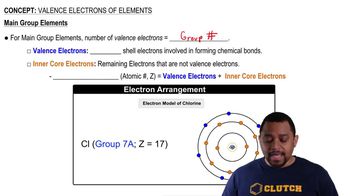
Valence electrons are the outermost electrons of an atom and are crucial for determining how an element will react chemically. They are involved in forming bonds with other atoms. The number of valence electrons can be determined from an element's position in the periodic table, which helps predict its chemical behavior.
Valence Electrons of Elements (Simplified) Concept 1
Electron Configuration
Electron configuration describes the distribution of electrons in an atom's orbitals. For elements in the p-block, such as sulfur, bromine, and silicon, the p subshell can hold a maximum of six electrons. Understanding the electron configuration allows us to visualize how electrons are arranged and paired in the valence shell, which is essential for drawing accurate representations.
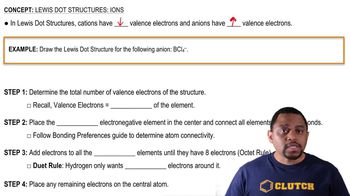
Lewis structures are diagrams that represent the bonding between atoms and the lone pairs of electrons in a molecule. They use dots to represent valence electrons and lines for bonds. In the context of the question, Lewis structures will help illustrate the electron pairing in the p subshell for sulfur, bromine, and silicon, providing a clear visual representation of their valence electron arrangements.

 6:04분
6:04분 검증된 단계별 안내
 01:55
01:55