An archeologist finds a 1.62 kg goblet that she believes to be made of pure gold. When 1350 cal (5650 J) of heat is added to the goblet, its temperature increases by 7.8 ℃. Calculate the specific heat of the goblet. Is it made of gold? Explain.
검증된 단계별 안내
1
Identify the formula for specific heat capacity: \( c = \frac{q}{m \cdot \Delta T} \), where \( q \) is the heat added, \( m \) is the mass, and \( \Delta T \) is the change in temperature.
Substitute the given values into the formula: \( q = 5650 \text{ J} \), \( m = 1.62 \text{ kg} \), and \( \Delta T = 7.8 \text{ ℃} \).
Calculate the specific heat capacity \( c \) using the substituted values.
Compare the calculated specific heat capacity with the known specific heat capacity of gold, which is approximately \( 0.129 \text{ J/g}^\circ\text{C} \) or \( 129 \text{ J/kg}^\circ\text{C} \).
Determine if the goblet is made of gold based on whether the calculated specific heat matches the known value for gold.
비슷한 문제에 대한 검증된 영상 답변:
이 영상 해법은 위 문제에 도움이 된다고 튜터들이 추천한 것입니다.
영상 길이:
1m
영상 재생:
0 댓글
주요 개념
질문에 올바르게 답하기 위해 반드시 이해해야 하는 핵심 개념들은 다음과 같습니다.
Specific Heat Capacity
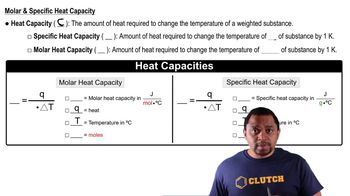
Specific heat capacity is the amount of heat required to raise the temperature of one gram of a substance by one degree Celsius. It is a material-specific property that helps in understanding how substances respond to heat. The formula to calculate specific heat is given by Q = mcΔT, where Q is the heat added, m is the mass, c is the specific heat capacity, and ΔT is the change in temperature.
Heat transfer refers to the movement of thermal energy from one object or substance to another due to a temperature difference. In this context, the heat added to the goblet causes its temperature to rise, which can be quantified using the specific heat capacity. Understanding heat transfer is essential for calculating how much energy is needed to change the temperature of a material.
To determine if the goblet is made of gold, we need to compare the calculated specific heat of the goblet with the known specific heat of gold, which is approximately 0.129 J/g°C. If the calculated value closely matches this, it supports the hypothesis that the goblet is made of pure gold. This comparison is crucial for validating the archeologist's assumption.

 1:37분
1:37분 검증된 단계별 안내
 02:19
02:19