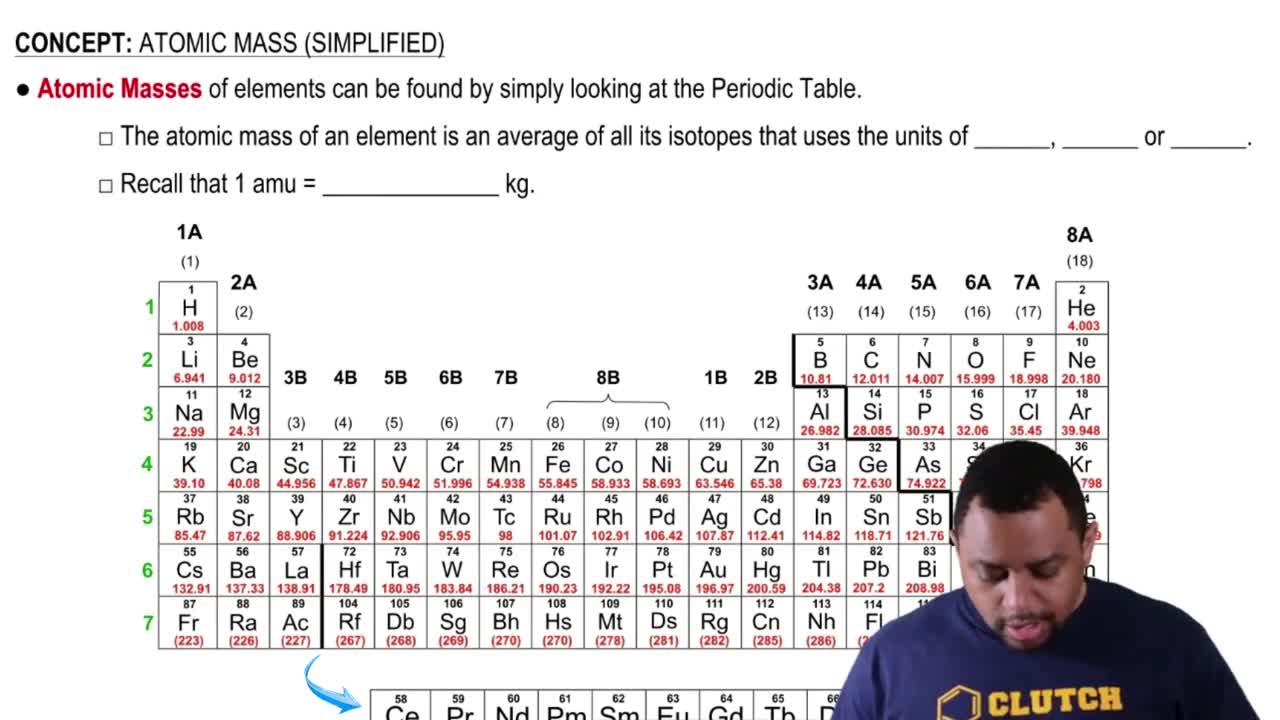
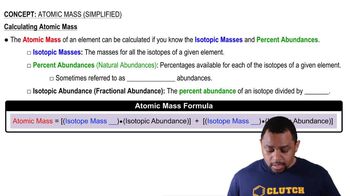
Indium consists of two isotopes, ¹¹³₄₉In and ¹¹⁵₄₉In. If the atomic mass for indium on the periodic table is 114.8, are there more atoms of ¹¹³₄₉In or ¹¹⁵₄₉In in a sample of indium?
검증된 단계별 안내
1
Identify the isotopes of indium: ¹¹³₄₉In and ¹¹⁵₄₉In.
Understand that the atomic mass of indium on the periodic table (114.8) is a weighted average of the masses of its isotopes.
Set up an equation for the average atomic mass: \( x \times 113 + (1-x) \times 115 = 114.8 \), where \( x \) is the fraction of ¹¹³₄₉In.
Solve the equation for \( x \) to find the relative abundance of ¹¹³₄₉In.
Compare the values of \( x \) and \( 1-x \) to determine which isotope is more abundant in the sample.
비슷한 문제에 대한 검증된 영상 답변:
이 영상 해법은 위 문제에 도움이 된다고 튜터들이 추천한 것입니다.
영상 길이:
1m
영상 재생:
0 댓글
주요 개념
질문에 올바르게 답하기 위해 반드시 이해해야 하는 핵심 개념들은 다음과 같습니다.
Isotopes
Isotopes are variants of a chemical element that have the same number of protons but different numbers of neutrons, resulting in different atomic masses. For example, indium has two isotopes: ¹¹³₄₉In with 64 neutrons and ¹¹⁵₄₉In with 66 neutrons. Understanding isotopes is crucial for analyzing atomic mass and abundance in a sample.
Atomic mass is the weighted average mass of an element's isotopes, measured in atomic mass units (amu). It reflects both the mass and relative abundance of each isotope in nature. In the case of indium, the atomic mass of 114.8 indicates that the isotopes are not present in equal amounts, which is key to determining the relative quantities of ¹¹³₄₉In and ¹¹⁵₄₉In.
Relative abundance refers to the proportion of each isotope of an element present in a sample. It can be calculated using the atomic mass and the masses of the isotopes. In this question, knowing the atomic mass of indium allows us to infer which isotope is more prevalent based on their respective contributions to the average atomic mass.

 1:33분
1:33분 검증된 단계별 안내
 04:36
04:36