Avogadro's number is a fundamental constant in chemistry that represents the number of atoms, molecules, or particles in one mole of a substance.
The value of Avogadro's number is approximately \(6.022 \times 10^{23}\).
This number allows chemists to convert between the number of particles and the amount of substance in moles.
Avogadro's number is named after the Italian scientist Amedeo Avogadro, who first proposed the concept of the mole.
Understanding Avogadro's number is crucial for calculations involving chemical reactions, stoichiometry, and molecular weights.
비슷한 문제에 대한 검증된 영상 답변:
이 영상 해법은 위 문제에 도움이 된다고 튜터들이 추천한 것입니다.
영상 길이:
1m
영상 재생:
0 댓글
주요 개념
질문에 올바르게 답하기 위해 반드시 이해해야 하는 핵심 개념들은 다음과 같습니다.
Avogadro's Number
Avogadro's number, approximately 6.022 x 10^23, is the number of atoms, molecules, or particles in one mole of a substance. This constant is fundamental in chemistry as it allows chemists to convert between the mass of a substance and the number of particles it contains, facilitating calculations in stoichiometry and molecular chemistry.
The mole is a unit in chemistry that quantifies the amount of substance. One mole corresponds to Avogadro's number of entities, whether they are atoms, molecules, or ions. This concept is crucial for understanding chemical reactions, as it provides a bridge between the macroscopic scale of substances we can measure and the microscopic scale of atoms and molecules.
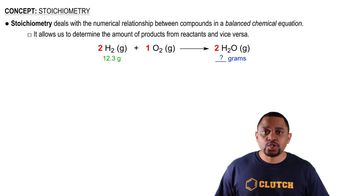
Stoichiometry is the area of chemistry that deals with the relationships between the quantities of reactants and products in chemical reactions. It relies on the mole concept and Avogadro's number to calculate how much of each substance is needed or produced in a reaction, allowing chemists to predict the outcomes of reactions and to scale them appropriately.

 1:41분
1:41분 검증된 단계별 안내
 03:13
03:13