A gas has a volume of 2.84 L at 1.00 atm and 0 °C. At what temperature does it have a volume of 7.50 L at 520 mmHg?
검증된 단계별 안내
1
Identify the initial and final conditions of the gas: initial volume (V1) = 2.84 L, initial pressure (P1) = 1.00 atm, initial temperature (T1) = 0 °C, final volume (V2) = 7.50 L, final pressure (P2) = 520 mmHg.
Convert all units to be consistent: convert the initial temperature from Celsius to Kelvin using T(K) = T(°C) + 273.15, and convert the final pressure from mmHg to atm using the conversion factor 1 atm = 760 mmHg.
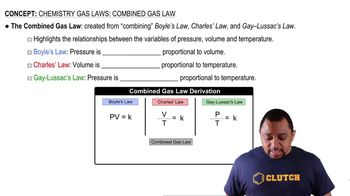
Use the combined gas law, which is \( \frac{P_1 \cdot V_1}{T_1} = \frac{P_2 \cdot V_2}{T_2} \), to relate the initial and final states of the gas.
Rearrange the combined gas law to solve for the final temperature \( T_2 \): \( T_2 = \frac{P_2 \cdot V_2 \cdot T_1}{P_1 \cdot V_1} \).
Substitute the known values into the equation and solve for \( T_2 \) in Kelvin.
비슷한 문제에 대한 검증된 영상 답변:
이 영상 해법은 위 문제에 도움이 된다고 튜터들이 추천한 것입니다.
영상 길이:
2m
영상 재생:
0 댓글
주요 개념
질문에 올바르게 답하기 위해 반드시 이해해야 하는 핵심 개념들은 다음과 같습니다.
Ideal Gas Law
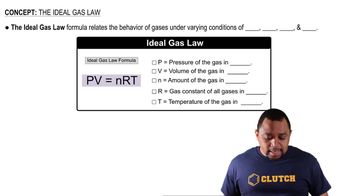
The Ideal Gas Law is a fundamental equation in chemistry that relates the pressure, volume, temperature, and number of moles of a gas. It is expressed as PV = nRT, where P is pressure, V is volume, n is the number of moles, R is the ideal gas constant, and T is temperature in Kelvin. This law allows us to predict the behavior of gases under different conditions.
Charles's Law states that the volume of a gas is directly proportional to its temperature when pressure is held constant. Mathematically, it can be expressed as V1/T1 = V2/T2. This concept is crucial for understanding how changes in temperature affect the volume of a gas, which is essential for solving the given problem.
In gas calculations, it is often necessary to convert pressure units to ensure consistency. In this case, the initial pressure is given in atmospheres (atm) and the final pressure in millimeters of mercury (mmHg). Knowing that 1 atm equals 760 mmHg allows for the conversion of pressure units, which is vital for applying gas laws correctly.

 2:52분
2:52분 검증된 단계별 안내
 01:15
01:15