The specific heat of fat is 0.45 cal/(g ⋅ °C) (1.9 J/g °C) and the density of fat is 0.94 g/cm^3. How much energy (in calories and joules) is needed to heat 10 cm^3 of fat from room temperature (25 degree C) to its melting point (35 degree C)?
검증된 단계별 안내
1
Determine the mass of the fat using its volume and density. Use the formula: \( \text{mass} = \text{density} \times \text{volume} \).
Calculate the change in temperature (\( \Delta T \)) by subtracting the initial temperature from the final temperature: \( \Delta T = 35^\circ C - 25^\circ C \).
Use the formula for heat energy: \( q = m \cdot c \cdot \Delta T \), where \( q \) is the heat energy, \( m \) is the mass, \( c \) is the specific heat capacity, and \( \Delta T \) is the change in temperature.
Substitute the values for mass, specific heat capacity in calories, and \( \Delta T \) into the formula to find the energy in calories.
Substitute the values for mass, specific heat capacity in joules, and \( \Delta T \) into the formula to find the energy in joules.
비슷한 문제에 대한 검증된 영상 답변:
이 영상 해법은 위 문제에 도움이 된다고 튜터들이 추천한 것입니다.
영상 길이:
2m
영상 재생:
0 댓글
주요 개념
질문에 올바르게 답하기 위해 반드시 이해해야 하는 핵심 개념들은 다음과 같습니다.
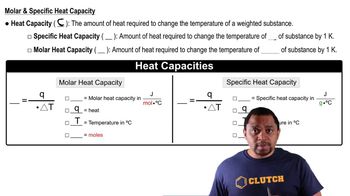
Specific Heat Capacity
Specific heat capacity is the amount of heat energy required to raise the temperature of a unit mass of a substance by one degree Celsius. It is a crucial concept in thermodynamics, as it determines how much energy is needed to change the temperature of a material. In this question, the specific heat of fat (0.45 cal/(g ⋅ °C) or 1.9 J/g °C) indicates how much energy is required to heat the fat.
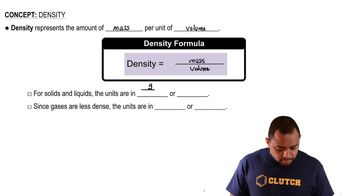
Density is defined as mass per unit volume and is a key property of materials. It helps in determining how much mass is contained in a given volume of a substance. In this case, the density of fat (0.94 g/cm³) allows us to calculate the mass of the fat when given its volume (10 cm³), which is essential for calculating the total energy required to heat it.
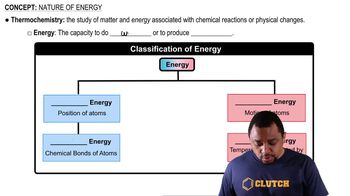
Energy calculation in thermodynamics often involves using the formula Q = mcΔT, where Q is the heat energy, m is the mass, c is the specific heat capacity, and ΔT is the change in temperature. This formula is fundamental for determining how much energy is needed to raise the temperature of a substance, as seen in this question where we need to calculate the energy required to heat fat from 25°C to 35°C.