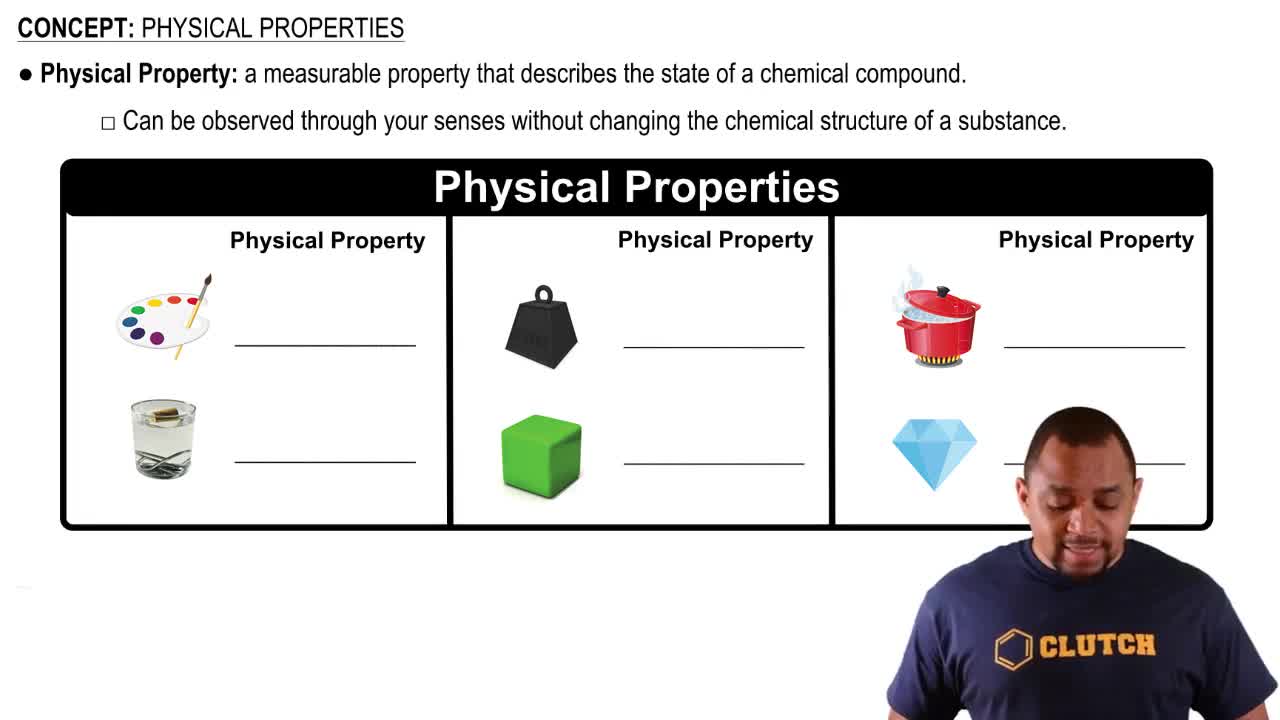
The gray cube has a density of 4.5 g/cm³. Is the density of the green cube the same, lower than, or higher than that of the gray cube? (2.7)
검증된 단계별 안내
1
Identify the density of the gray cube, which is given as 4.5 g/cm³.
Note the density of the green cube, which is given as 2.7 g/cm³.
Compare the two densities: 4.5 g/cm³ for the gray cube and 2.7 g/cm³ for the green cube.
Determine if 2.7 g/cm³ is less than, equal to, or greater than 4.5 g/cm³.
Conclude that the density of the green cube is lower than that of the gray cube.
비슷한 문제에 대한 검증된 영상 답변:
이 영상 해법은 위 문제에 도움이 된다고 튜터들이 추천한 것입니다.
영상 길이:
1m
영상 재생:
0 댓글
주요 개념
질문에 올바르게 답하기 위해 반드시 이해해야 하는 핵심 개념들은 다음과 같습니다.
Density
Density is defined as mass per unit volume, typically expressed in grams per cubic centimeter (g/cm³). It is a physical property that helps identify substances and can indicate whether an object will float or sink in a fluid. In this context, the density of the gray cube is given as 4.5 g/cm³, which serves as a reference point for comparison with the green cube.
When comparing the densities of two objects, one can determine which is denser by examining their mass and volume. If the green cube has a greater mass for the same volume as the gray cube, it will have a higher density. Conversely, if it has less mass, its density will be lower. This comparison is crucial for answering the question regarding the green cube's density relative to the gray cube.
Different materials have characteristic densities that can help identify them. For example, metals typically have higher densities than plastics or wood. Understanding the material properties of the cubes can provide insights into their densities. If the green cube is made of a lighter material than the gray cube, it is likely to have a lower density, while a denser material would suggest a higher density.

 1:15분
1:15분
 검증된 단계별 안내
 01:56
01:56