Which of the following elements would you expect to form (iv) both covalent and ionic bonds? (More than one answer may apply; remember that some nonmetals can form ionic bonds with metals.) Explain your answers.
a.Oxygen
b.Potassium
c.Phosphorus
d.Iodine
e.Hydrogen
f.Cesium
검증된 단계별 안내
1
Identify the nature of each element: Determine if each element is a metal, nonmetal, or metalloid. Metals typically form ionic bonds, while nonmetals can form covalent bonds.
Consider the ability to form covalent bonds: Nonmetals are more likely to form covalent bonds with other nonmetals. Identify which elements are nonmetals.
Consider the ability to form ionic bonds: Metals tend to form ionic bonds with nonmetals. Identify which elements are metals and which are nonmetals.
Evaluate each element: For each element, determine if it can form both covalent and ionic bonds based on its classification as a metal or nonmetal and its typical bonding behavior.
Select the elements: Choose the elements that can form both types of bonds based on the analysis of their chemical properties and bonding capabilities.
비슷한 문제에 대한 검증된 영상 답변:
이 영상 해법은 위 문제에 도움이 된다고 튜터들이 추천한 것입니다.
영상 길이:
2m
영상 재생:
0 댓글
주요 개념
질문에 올바르게 답하기 위해 반드시 이해해야 하는 핵심 개념들은 다음과 같습니다.
Covalent Bonds
Covalent bonds are formed when two nonmetals share electrons to achieve a full outer shell, resulting in a stable electronic configuration. This type of bonding typically occurs between elements with similar electronegativities, allowing them to effectively share electrons rather than transferring them. For example, oxygen and hydrogen can form water (H2O) through covalent bonding.
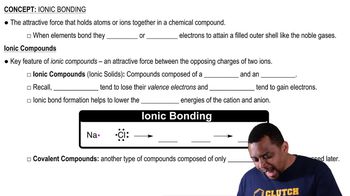
Ionic bonds occur when one atom donates an electron to another, resulting in the formation of charged ions. This typically happens between metals and nonmetals, where metals lose electrons to become positively charged cations, and nonmetals gain electrons to become negatively charged anions. An example is sodium chloride (NaCl), where sodium donates an electron to chlorine.
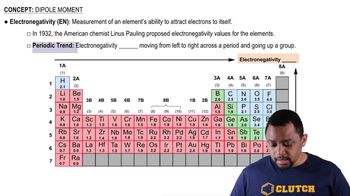
Electronegativity is a measure of an atom's ability to attract and hold onto electrons in a chemical bond. Elements with high electronegativity, such as oxygen and iodine, are more likely to form covalent bonds with other nonmetals, while those with low electronegativity, like potassium and cesium, tend to form ionic bonds with nonmetals. Understanding electronegativity helps predict the type of bond that will form between different elements.

 2:16분
2:16분 검증된 단계별 안내
 01:18
01:18