Consider the following Lewis symbols for elements X and Y: (6.1, 6.2, 6.5)
c. What ions would be formed by X and Y?
검증된 단계별 안내
1
Identify the number of valence electrons for each element based on the Lewis symbols: M has 6 valence electrons and N has 1 valence electron.
Determine the tendency of each element to gain or lose electrons to achieve a stable electron configuration: M will likely gain 2 electrons to complete its octet, while N will likely lose 1 electron to achieve a stable configuration.
Predict the ions formed: M will form an anion by gaining electrons, and N will form a cation by losing an electron.
Write the expected ions: M will form M^{2-} and N will form N^{+}.
Consider the charge balance in a compound formed by these ions: The compound would be neutral if two N^{+} ions combine with one M^{2-} ion.
비슷한 문제에 대한 검증된 영상 답변:
이 영상 해법은 위 문제에 도움이 된다고 튜터들이 추천한 것입니다.
영상 길이:
3m
영상 재생:
0 댓글
주요 개념
질문에 올바르게 답하기 위해 반드시 이해해야 하는 핵심 개념들은 다음과 같습니다.
Lewis Dot Structures
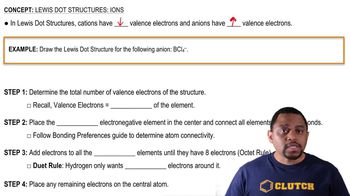
Lewis dot structures are diagrams that represent the valence electrons of an atom. Each dot corresponds to a valence electron, and the arrangement of these dots helps visualize how atoms bond with each other. Understanding these structures is crucial for predicting how elements will interact and form ions.
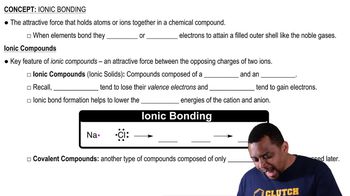
Ionic bonding occurs when atoms transfer electrons to achieve full valence shells, resulting in the formation of ions. Typically, metals lose electrons to become positively charged cations, while nonmetals gain electrons to become negatively charged anions. This transfer of electrons leads to the electrostatic attraction between oppositely charged ions.
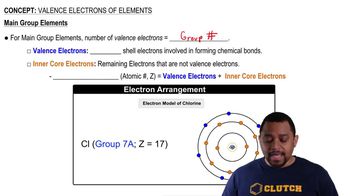
Valence electrons are the outermost electrons of an atom and play a key role in chemical bonding. The number of valence electrons determines an element's reactivity and the types of ions it can form. Elements tend to lose, gain, or share valence electrons to achieve a stable electron configuration, often resembling that of noble gases.

 3:54분
3:54분
 검증된 단계별 안내
 03:11
03:11