Write equations for the loss of an electron by a K atom and the gain of an electron by a K+ ion.
검증된 단계별 안내
1
Identify the initial species involved in each process: a neutral potassium atom (K) and a potassium ion (K⁺).
For the loss of an electron by a K atom, write the equation: K → K⁺ + e⁻. This represents the ionization of potassium, where a neutral potassium atom loses one electron to form a positively charged ion.
For the gain of an electron by a K⁺ ion, write the equation: K⁺ + e⁻ → K. This represents the reduction process, where a potassium ion gains an electron to become a neutral potassium atom.
Understand that these processes are examples of oxidation and reduction. The loss of an electron (K to K⁺) is oxidation, and the gain of an electron (K⁺ to K) is reduction.
Review the concept of oxidation states: In the first equation, the oxidation state of K changes from 0 to +1, and in the second equation, it changes from +1 to 0.
비슷한 문제에 대한 검증된 영상 답변:
이 영상 해법은 위 문제에 도움이 된다고 튜터들이 추천한 것입니다.
영상 길이:
2m
영상 재생:
0 댓글
주요 개념
질문에 올바르게 답하기 위해 반드시 이해해야 하는 핵심 개념들은 다음과 같습니다.
Ionization Energy
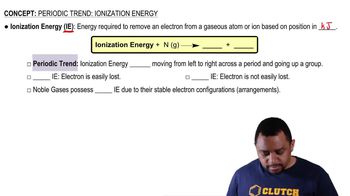
Ionization energy is the energy required to remove an electron from an atom in its gaseous state. For potassium (K), this process involves overcoming the attraction between the negatively charged electron and the positively charged nucleus. The equation for the loss of an electron from a K atom can be represented as K(g) → K⁺(g) + e⁻, indicating that an electron is removed, resulting in a positively charged ion.
Periodic Trend: Ionization Energy (Simplified) Concept 1
Electron Affinity
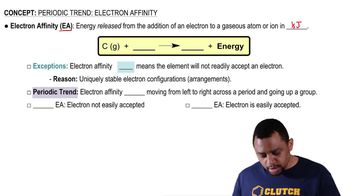
Electron affinity refers to the energy change that occurs when an electron is added to a neutral atom in the gaseous state. For a potassium ion (K⁺), gaining an electron results in the formation of a neutral potassium atom. The equation for this process is K⁺(g) + e⁻ → K(g), which shows that the addition of an electron to K⁺ releases energy, making the process exothermic.
Periodic Trend: Electron Affinity (Simplified) Concept 1
Atomic Structure
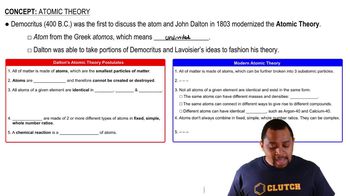
The atomic structure of an element defines the arrangement of protons, neutrons, and electrons within an atom. Potassium has 19 electrons, with its outermost electron in the fourth energy level. Understanding atomic structure is crucial for predicting how potassium will interact with electrons, including its tendency to lose an electron to form K⁺ and its ability to gain an electron to revert to a neutral state.

 2:분
2:분 검증된 단계별 안내
 02:13
02:13