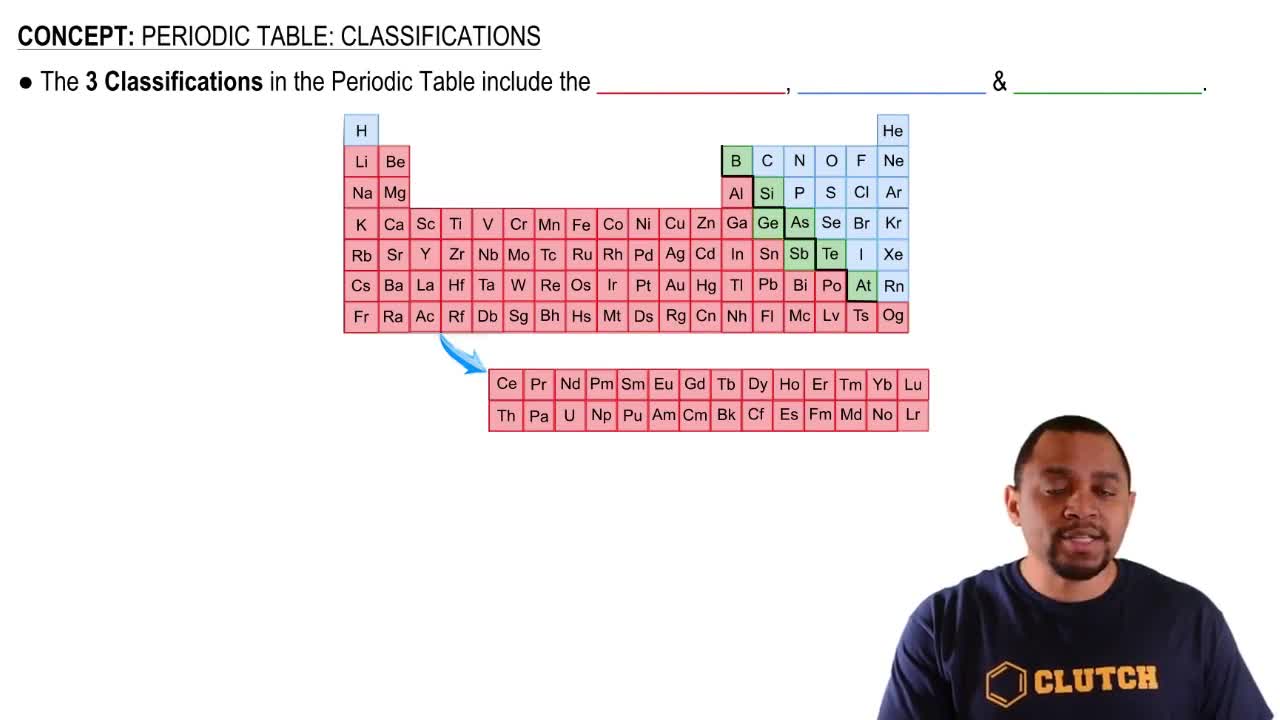
Use the following blank periodic table to show where the elements matching the following descriptions appear.
a. Elements with the valence-shell electron configuration ns^2 np^5
b. An element whose third shell contains two p electrons
c. Elements with a completely filled valence shell
검증된 단계별 안내
1
Identify the group of elements with the valence-shell electron configuration ns^2 np^5. These are the halogens, located in Group 17 of the periodic table.
Locate the element whose third shell contains two p electrons. This corresponds to an element in the third period with a 3p^2 configuration, which is silicon (Si).
Identify the elements with a completely filled valence shell. These are the noble gases, located in Group 18 of the periodic table.
Mark the halogens (Group 17) on the periodic table image. These include elements like fluorine (F), chlorine (Cl), bromine (Br), iodine (I), and astatine (At).
Mark the noble gases (Group 18) on the periodic table image. These include elements like helium (He), neon (Ne), argon (Ar), krypton (Kr), xenon (Xe), and radon (Rn).
비슷한 문제에 대한 검증된 영상 답변:
이 영상 해법은 위 문제에 도움이 된다고 튜터들이 추천한 것입니다.
영상 길이:
3m
영상 재생:
0 댓글
주요 개념
질문에 올바르게 답하기 위해 반드시 이해해야 하는 핵심 개념들은 다음과 같습니다.
Valence Shell Electron Configuration
The valence shell electron configuration describes the distribution of electrons in the outermost shell of an atom. It is crucial for determining an element's chemical properties and reactivity. For example, the configuration ns^2 np^5 indicates that the element has two electrons in the s subshell and five in the p subshell of its outermost energy level, characteristic of halogens.
Valence Shell Electron Pair Repulsion Theory (Simplified) Concept 1
Electron Shells and Subshells
Electron shells are the regions around an atom's nucleus where electrons are likely to be found, with each shell corresponding to a principal energy level. Subshells (s, p, d, f) further divide these shells based on the shape of the electron cloud. Understanding how many electrons occupy each shell and subshell is essential for identifying elements based on their electron configurations.
The periodic table organizes elements based on their atomic number and electron configurations, reflecting periodic trends in properties. Elements are grouped into columns (groups) that share similar chemical behaviors, while rows (periods) indicate the number of electron shells. This organization helps in predicting the location of elements based on their electron configurations, such as identifying noble gases with a completely filled valence shell.

 3:38분
3:38분
 검증된 단계별 안내
 01:04
01:04